

EMF Protection Necklaces and Pendants: Claims and Evidence
*The information on EMF Academy is for educational purposes only and is not a substitute for professional medical advice. Please review our full Medical Disclaimer for more details. This post may contain affiliate links. Please see my disclosure to learn more.
I’ve worn and written about several necklaces sold for EMF protection. Earlier versions of this guide recommended them much more strongly than the evidence justified. Owning a pendant, liking its design or feeling better while wearing it does not establish that it reduces exposure or protects your health.
If you’re shopping for one now, I would start with the claim rather than a ranked list. What is the seller promising: measured shielding, a change in a biological marker, or relief from symptoms? Those require different evidence. I would not buy a necklace on the promise that it protects the brain, heart or other organs.
Below, I revisit the five products or materials previously covered here, explain what to ask before spending money and address the official warnings about certain “negative ion” products. This is an evidence review, not a new hands-on test of current models.
Do EMF protection necklaces and pendants work?
There is no sound basis in the sources reviewed here for ranking these pendants as proven health protection. A seller’s explanation of how a stone or device is supposed to work is a starting point for checking a claim, not the result of that check.
For a shielding claim, look for a test of the finished product in the way it is actually worn. The report should identify the frequencies, measurement method, arrangement and result. A laboratory test of a material sample does not tell you how much exposure a small pendant changes elsewhere on your body. A decibel figure without those conditions does not answer the buying question.
For a health claim, ask whether a suitable human study measured the advertised outcome with that product. A change in EEG or another marker does not, on its own, demonstrate prevention of illness or treatment of headaches. Testimonials and before-and-after demonstrations also cannot settle whether a pendant caused an improvement.
That is why I’ve removed the old “best overall protection” recommendation and sales links from this guide. You can still compare the designs below, but the table is not a ranking of medical effectiveness.
Compare the five necklaces and materials previously covered
| Earlier pick | What it is | The limitation |
|---|---|---|
| Aires Lifetune Go | An earlier Aires wearable design | The company describes field modulation rather than signal attenuation |
| Q-Link SRT-3 | A proprietary pendant, including acrylic versions | Claims about resonance and resilience are not a quantified shielding result |
| Karelian Heritage shungite | A stone pendant | A material description does not prove whole-body protection |
| Ayana black tourmaline | A crystal necklace | Ion or energy claims do not establish a clinical benefit |
| Ayana orgonite | A composite pendant sold with energy-related claims | Reiki or resonance language does not establish exposure reduction |
Aires Lifetune Go: revisit the protection claim

I previously described the Lifetune Go as my favorite protection pendant and mentioned my family’s use of Aires products. That history does not establish that a pendant protects organs or prevents harm.
Aires’s current technology overview describes structural field modulation and says signal amplitude is unchanged. That is the company’s description, not an independently verified reduction in exposure. It also differs from calling the device a shield that blocks or absorbs radiation.
The old guide treated research spending, patents and published study counts as proof of protection. Those facts, even when verified, do not establish the clinical benefit of a particular necklace. Read our updated Aires review for a closer look at the claims and evidence. The older Go photo here should not be mistaken for a test or recommendation of the current product line.
Q-Link SRT-3: resonance claims need their own evidence
The Q-Link FAQ describes its Sympathetic Resonance Technology as supporting the body’s energy system. The company distinguishes that approach from products that claim to shield, block or neutralize EMF. Its medical disclaimer says its products are not intended to prevent, treat or diagnose disease.
I would not turn that explanation into a claim that a Q-Link necklace reduces the amount of RF energy your body absorbs. If a particular health benefit matters to you, ask for the relevant product study and examine its design and outcome. Celebrity use and customer stories do not establish that benefit.
Shungite: a stone pendant is not a shielding enclosure
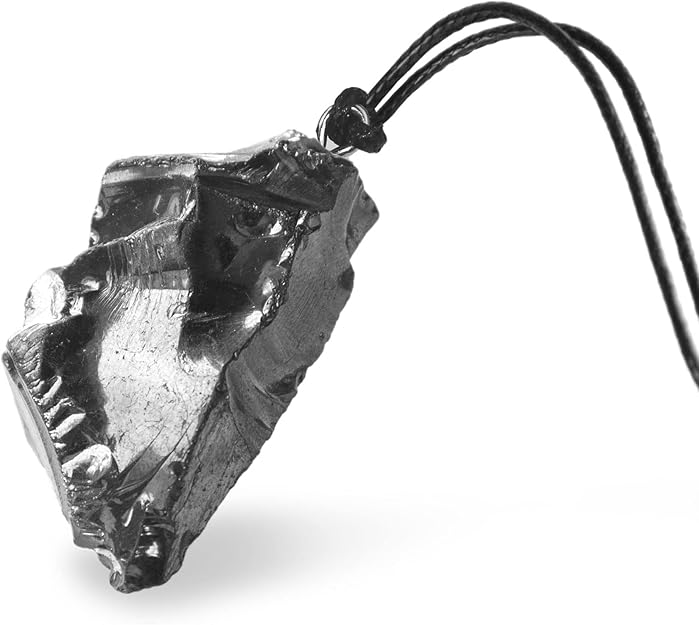
What a shungite material claim can tell you
The earlier pick was a Karelian Heritage shungite pendant. Its appearance may appeal to you as jewelry. Claims about carbon content, fullerenes or where a stone came from do not establish a health benefit from wearing it.
Even a relevant shielding measurement on a sample would need its test conditions explained. It cannot simply be applied to a small stone hanging at the chest and described as protection for the entire body. I would choose a stone necklace for its design and construction, rather than pay more because it promises protection from nearby devices.
Black tourmaline: avoid the leap from a crystal to treatment
The Ayana black tourmaline necklace was another earlier pick. The old article linked claims about ions and electrical properties to protection of the wearer, and presented positive reviews as evidence of health changes. That connection was not adequately supported.
A stone’s physical properties and a necklace’s clinical effectiveness are separate questions. I would not recommend tourmaline jewelry to treat symptoms or increase the body’s resistance to EMF. You can enjoy the look or personal meaning of a crystal without treating it as a medical product.
Orgonite: energy language does not establish protection

The earlier Ayana orgonite section described a composite pendant with tourmaline and repeated claims about Reiki charging and resonance. It then suggested benefits for sleep, mood, energy, immunity and symptoms attributed to EMF. Those recommendations exceeded the evidence presented.
Words such as “charged,” “harmonized” or “balanced” do not tell a buyer what was measured. Ask the seller to define the result and provide evidence for the exact product. I would not assume that an unverified charge is beneficial, harmless or necessary to make the necklace useful as jewelry.
The official warning about some negative ion products
The U.S. Nuclear Regulatory Commission reports that some products marketed with negative ion, scalar or quantum claims contain radioactive material. It also explicitly says others do not. Its assessment describes likely low whole-body doses from certain pendants and wristbands, with the possibility of elevated skin exposure from continuous wear.
The Dutch ANVS warning from December 2021 identifies particular products that exceeded local limits. That is a warning about the listed items, not a finding that every crystal necklace is radioactive. Neither source, as reviewed for this update, establishes that the Aires, Q-Link, Karelian Heritage or Ayana products discussed above were tested and found radioactive.
If you own a negative ion product, check the regulator’s product information and instructions. The NRC advises discarding these products and allows common-trash disposal in the U.S.; the Dutch warning tells owners of its listed items not to put them in household waste. Follow the relevant authority for your location. Do not infer composition or radioactivity from a product photo.
Questions to ask before buying a necklace
Ask for the exact model and what the price includes. Confirm the pendant’s size, weight, cord or chain, materials, care instructions and return conditions. The old guide’s price categories and accessory details are not a current price or availability check.
If the seller advertises shielding, request the finished-product report and the wearing arrangement tested. If it advertises a health benefit, request the human evidence for that outcome. Check who conducted or funded the study, whether there was an appropriate comparison and whether the result applies to that model. A patent is not a medical approval.
If those answers are missing, I would not pay a protection premium. A necklace can be a piece of jewelry or something personally meaningful without carrying a promise about health. Buying several unverified pendants does not resolve the evidence gap.
What to do instead depends on your goal
If you want to keep a phone away from your head during calls, speakerphone or a suitable headset can do that. The National Cancer Institute’s guidance describes hands-free use as a way to reduce RF exposure to the head. It does not say a protection necklace is required. You may already have a suitable option, so start there.
If your question is about measuring a particular field, see our EMF meter comparison and check the frequency range for the job. A consumer meter does not diagnose a condition, and buying one is not an automatic requirement for someone experiencing symptoms.
Symptoms deserve attention even when their cause is unclear. In its 2005 backgrounder on electromagnetic hypersensitivity, WHO recognizes that reported symptoms are real and can be disabling, while stating that a link to EMF exposure has not been scientifically established. That older document is not a new clinical review. Discuss persistent symptoms with a qualified clinician rather than assuming a necklace will treat them.
Common questions
Which EMF protection necklace should I buy?
I would not choose any of the five earlier picks on the promise of proven health protection. Compare materials, construction and design if you want jewelry. A protection claim needs evidence for the exact product and advertised outcome.
Can shungite or tourmaline protect the whole body?
A material property or a test on a sample does not establish whole-body protection from wearing a small pendant. Ask for a test of the finished product in its actual wearing arrangement, and distinguish a shielding result from a clinical benefit.
Are all negative ion necklaces radioactive?
No. The NRC states that some such products contain radioactive material and others do not. Check official product information; the warnings reviewed here do not establish that the particular brands in this guide were tested and found radioactive.
Does an EMF bracelet solve the same problem?
Changing a pendant to a bracelet does not remove the need for evidence. Ask what the exact product measures or claims to do. Do not assume that either form prevents illness, treats symptoms or provides complete protection.




I have been coming to your blog for a long time now… I find you writing brilliant. Keep it up!
I have been coming to your site for 1 year now. I find that it is informative and well thought through. Keep up the great blogging!
I’ve just discovered your website and I have to say a very big THANK YOU for sharing all your knowledge with others. It means a lot. Especially for me as I’m hyper sensitive to EMF radiation and chemicals. They have just rolled out 5G in my apartment building two days ago and it’s making me very sick – the usual symptoms but more intense especially in the brain and aching pains in the heart region. Just when I thought I had all my computers and wifi shielded now I have to wear the EMF clothing non-stop until I can get out of this place. And go where? At least we humans can find protective devices and clothing, it’s the animals, birds and plants I feel sorry for. What are they doing to our beautiful world?
Just getting familiar with your site, thanks for sharing.
Any comments on the Graham Stetzer filters?
Thank you