

Do EMF Protection Stickers Work? Claims and Test Results
*The information on EMF Academy is for educational purposes only and is not a substitute for professional medical advice. Please review our full Medical Disclaimer for more details. This post may contain affiliate links. Please see my disclosure to learn more.
I wouldn’t buy an EMF sticker on a promise of proven health protection. I’ve used Aires and Q-Link accessories on devices in my own home and office. Earlier versions of this guide treated that experience, company research pages and testimonials as reasons to recommend protection stickers. Those are not enough to establish that a sticker reduces exposure or protects someone’s health.
My buying advice is to ask for evidence of the exact result being advertised. A small patch with a shielding claim, a device said to change a field and a product promising symptom relief need different tests. I would not choose a sticker just because its packaging says “5G protection” or because a seller shows an impressive-looking demonstration.
This update revisits the six brands previously covered here. It separates manufacturer claims, laboratory measurements and human-study findings, and removes the old blanket recommendations. The photos come from earlier versions of the article; this is not a new hands-on comparison of current products.
What would prove an EMF sticker works?
First, define “works.” Is the seller claiming lower RF power at a measurement point, lower absorption in a specified test, a change in a physiological marker, or prevention of disease? A result for one of those does not automatically establish the others.
For a physical shielding or redirection claim, request the full finished-product report. Check the phone or earbud model, accessory version, frequencies, operating modes, placement, measurement geometry and comparison. A reduction on one side or in one arrangement cannot simply be applied to every device and every way of using it.
For a health claim, look for suitable human evidence measuring that outcome. An isolated DNA experiment, a thermal image or a change in a short-term physiological marker is not, by itself, proof that a product prevents illness or treats symptoms. That is a limitation on what the result establishes, rather than a reason to ignore the report.
If a company says its product does not attenuate a signal, an unchanged consumer meter reading cannot establish the claimed benefit. Nor does it prove that benefit is real but beyond measurement. The claim still needs a suitable test. Reviews and personal impressions cannot resolve that evidence gap.
The FTC’s September 2011 consumer alert warns that shields covering only a small part of a phone do not establish meaningful exposure reduction and may interfere with the signal. That historical warning is relevant buying advice; it is not a new laboratory assessment of every product sold today. I would not assume a newer product is an exception without checking its own evidence.
Compare the six products previously covered
On a phone, swipe the table sideways to read all three columns. With a keyboard, focus the table and use the left and right arrow keys.
| Product | Evidence considered here | What to keep in mind |
|---|---|---|
| Aires Lifetune Device | Manufacturer claims about field modulation | Not a demonstrated shielding result or proof of organ protection |
| WaveBlock | Manufacturer-hosted laboratory report library | Match the report to the exact device, product and test setup |
| Q-Link CLEAR | Proprietary resonance and energy-system claims | Do not translate those claims into measured exposure reduction |
| Aulterra Neutralizer | Manufacturer-hosted research and neutralization claims | Review the actual endpoint, not a patent or study count |
| EarthCalm Quantum Cell | A 2014 report using DNA solutions and an iPhone3 | That experiment is not a trial showing protection of people |
| energydots smartDOT | A 2021 sham-controlled physiological pilot with 12 volunteers | Short-term marker changes do not establish prevention of illness |
Aires: field-modulation claims are different from shielding

The earlier article described the Lifetune Device as the best sticker for phone radiation, including 5G and millimeter waves. It also claimed protection for almost any electronic device and a five-foot range. Those statements were stronger than the evidence presented.
Aires’s current technology overview describes structural field modulation and says signal amplitude is unchanged. That is the company’s proposed mechanism, not independent confirmation that the accessory reduces absorbed RF energy or makes a device medically safe.
Research spending, patents and EEG demonstrations do not automatically establish those outcomes. Our updated Aires review examines the claims and research more closely. I’ve removed the old sales pitch here rather than repeat a protection guarantee based on my historical use.
WaveBlock: read the scope of the laboratory report
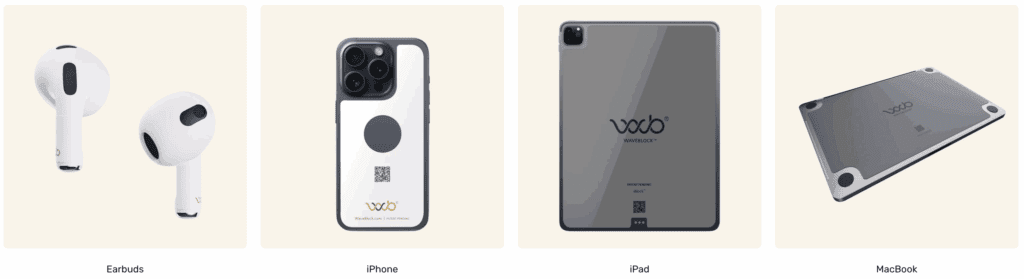
WaveBlock’s laboratory report library links to reports attributed to several testing organizations. Having a report available is useful, but the laboratory name and a patent do not answer which product, device and outcome were tested.
For example, the introduction and scope pages of a TÜV SÜD report hosted by WaveBlock identify a July 2020 relative-power comparison using representative wireless AirPods, two samples and a fixed configuration under the manufacturer’s test plan. That is narrower than proof for every current iPhone, tablet, laptop or earbud.
This comparison covers those scope pages, not every measurement or every report in the library. Before relying on a reduction claim, match the complete report to the exact accessory and device you would buy. A relative-power measurement is also a different outcome from reduced illness or symptom relief. This guide does not assign the entire product range a verified reduction percentage.
Q-Link CLEAR: do not treat resonance as an exposure measurement
The Q-Link FAQ presents its approach as support for the body’s energy system and distinguishes it from shielding, blocking or neutralizing EMF. Its medical disclaimer does not claim disease prevention or treatment.
The earlier guide’s account of buying CLEAR bundles and using them at home is personal history. It does not establish protection, and combining a sticker with a phone case does not establish “double protection.” I would ask for evidence supporting the specific advertised benefit before paying for it.
Aulterra: read the result behind the neutralization claim
Aulterra’s research page lists reports and describes a mineral-based neutralizing mechanism. It also says its products do not block, remove or absorb EMF. I have not treated that manufacturer description or the number of listed studies as a verified health outcome.
A relevant report needs its methods, comparison and endpoint examined. Ask whether it measured an electrical or laboratory response, a short-term human marker or the benefit the seller promises you. The old suggestion that someone could simply feel protection working, or should try several products to find out, was not a reliable way to establish effectiveness.
EarthCalm: the DNA experiment is not a human protection trial
A 2014 Quantum Cell report describes measurements on human DNA solutions in glass vials using an iPhone3, including standby and receiving conditions. It reports conductivity results after applying a Quantum Cell.
That is a laboratory experiment on a biomolecule, not a clinical trial showing that people using current phones are protected from illness. The article previously turned the manufacturer’s account into a claim about reversing harmful effects. I would not apply that conclusion to a buyer’s health without appropriate human evidence. This distinction does not claim to be a complete review of every EarthCalm study.
smartDOT: a small pilot needs a limited interpretation

The February 2021 BION report describes a randomized, double-blind, sham-controlled test commissioned by Global EMF Solutions. Twelve volunteers were measured in two 45-minute sessions. Its protocol placed a phone near the head and repeatedly called it during a five-minute interval, leaving it ringing rather than documenting an ordinary conversation.
The authors interpret differences in physiological measurements as a calming effect. That finding does not establish a reduction in RF absorption, headache treatment or long-term protection from disease. A buyer should keep the measured outcome separate from the broader protection language.
The linked March 2021 peer-review document is a two-page appraisal of that pilot by Beverly Rubik. It is not a second experiment. The earlier guide’s brief “peer-reviewed study” label omitted useful context about what readers could actually inspect.
Check the exact device and the exact promise
If you still want to evaluate an accessory, identify the precise phone or earbud model, the accessory version and the placement in its test report. Ask whether the report covers the device’s relevant radios and its operation with a case. Do not infer compatibility from a picture showing several devices or from the phrase “works with 5G.”
Read the total price, what comes in the package, whether removal prevents reuse and the return conditions. A refund policy can make a purchase easier to reverse; it cannot establish effectiveness. I would not buy multiple patches just because a company says more layers provide more protection.
For installation and ordinary device compatibility, follow the exact manufacturer instructions. There is no universal “put it in the middle” or “put it by the top antenna” rule that proves exposure reduction. The old iPhone example should not be applied to every model, region or generation.
What to do instead depends on your actual goal
If you want to keep your phone away from your head during a call, try speakerphone or a suitable headset you already own. The National Cancer Institute’s guidance describes hands-free use as a way to reduce RF exposure to the head. It does not require a protection sticker, a special headset or a new case purchase.
If you are comparing field readings, our EMF meter guide explains why range and units matter. A consumer meter cannot diagnose symptoms or establish a clinical benefit. An unchanged reading is not proof of successful neutralization, and one lower reading is not proof of protection in every situation.
A phone case can be useful for fit, grip and drop protection. A shielding-material result, however, is not automatically a finished-case or whole-phone exposure result. I’ve removed the previous claim that any quality shielding case necessarily protects far more than a sticker.
If symptoms are the reason you are shopping, give them proper medical attention. WHO’s 2005 electromagnetic-hypersensitivity backgrounder recognizes that reported symptoms are real and can be disabling, while stating that a link to EMF exposure has not been scientifically established. That older backgrounder is not a new clinical review. A personal change in symptoms does not by itself validate an accessory’s protection claim.
Common questions
Do EMF protection stickers work?
The result needs to be defined and tested. A measurement on a particular device and setup does not establish a health benefit or apply automatically to other products. This guide does not recommend a sticker on the promise of proven disease prevention or symptom treatment.
Where do I put an EMF sticker on an iPhone?
There is no universal location that proves protection. Check the exact accessory instructions and the phone model covered by its report. The old advice to use the middle of the phone or a presumed antenna location is not sufficient evidence.
Do Apple Watch radiation blockers work?
Do not assume a phone-accessory result applies to a watch. A relevant claim needs testing of the exact watch, accessory, radio operation and wearing arrangement. A product label or a change in one meter reading cannot establish a clinical benefit.
What can I use instead of an EMF sticker?
For keeping a phone away from your head during calls, speakerphone or a suitable existing headset is a practical option. Buying a shielding case or meter is not an automatic requirement. Seek medical evaluation for persistent symptoms rather than relying on a protection accessory.






Thanks for posting your honest opinion. I often wonder about these stickers. I have a shunghite disc on my phone and use the harmony pendant. Going by feel is really the only way to tell. I also have a safeshield phone case on my phone.
I have noticed a slight difference and I am EMF sensitive. I always have my phone in airplane mode or turned off despite the disc and phone case as well. Keep these articles coming. I am really concerned about the upcoming 5G and its health affects on all living beings.
Hey Tammy! Glad you enjoyed the articles and thanks for giving your opinion! I’m glad you’re noticing a difference with the products you’re using, and it sounds like you are doing all the right stuff! I’ll have some articles coming out soon on 5G, I agree, it’s a huge concern.
Update, October 10, 2026: My earlier reply was too confident about these products. Feeling better doesn’t establish that a sticker reduces exposure or protects health, and I overstated the concern about 5G. The revised guide explains what the tests can establish. Persistent symptoms deserve proper medical evaluation.
Hey Pierre!
That’s an interesting question, I’m not sure what the best way to go about this would be.
I would love your opinion on this product ~
https://hippocratesinst.org/shop/hhi-pulse
Thank you. I am so grateful I found you on the net. My husband died in October of a brain tumor, and I do believe it was caused by EMF’s (he was a computer consultant, always on cellphone to his head, and router right on his desk). I am grateful to learn the share the knowledge
Hey Diana! I’ll look into that product! I’m so glad you appreciate the website, I do it for people just like you!
Hi Christian
have you seen this video / product?
https://www.youtube.com/watch?v=KaZ43A2vIOI&feature=youtu.be&fbclid=IwAR3k15BvZm6INXcm_s65Z3_u24FbL-m2-W601592HyD5XfiyCbU1zYQj3SI
Interested on your thoughts on the testing method shown as well as the product….
Hey Steve!
I just watched the video, I hadn’t seen it before, nor had I heard of the product. The product is similar in design and concept to some of the products I reviewed in this article, but I’m going to reach out to them to learn more and test the products for myself (the best I can). As far as the testing method in the video, it is far from conclusive. A mountain of research shows us that EMF radiation does not need to have a thermal aspect whatsoever to cause damage, so a heat map of the head does not tell us anything about the radiation being absorbed.
I think it’s a flawed test, that is visual convincing, which is why they used it.
Update, October 10, 2026: My earlier broad statement about damage was stronger than the evidence I explained here. I also shouldn’t have guessed why the video makers chose that demonstration. A thermal image alone doesn’t establish how much radiofrequency energy is absorbed or whether a protection product provides a health benefit. The revised guide explains the limits of these tests.
Hi Christian
I’ve heard a lot about shungite lately. How does it rate as an EMF radiation shield?
Hi Christian, thank you so much for all the fantastic work that you do, and for sharing all this information which essentially is life changing for our families.
I was told that the Tesla Blushield EMF protection devices are great for overall home protection etc. I looked at some feedback online it seems that there are both positive and negative testimonials; a few Youtube review videos seem too ‘sales-y’ and inauthentic.
The Tesla series is very pricey and before investing I thought my first stop is to come to you for advice.
Thanks!
Sandra
Hey Sandra!
I’ve heard of these products but haven’t tried them myself, let me look into them a bit more and get back to you!