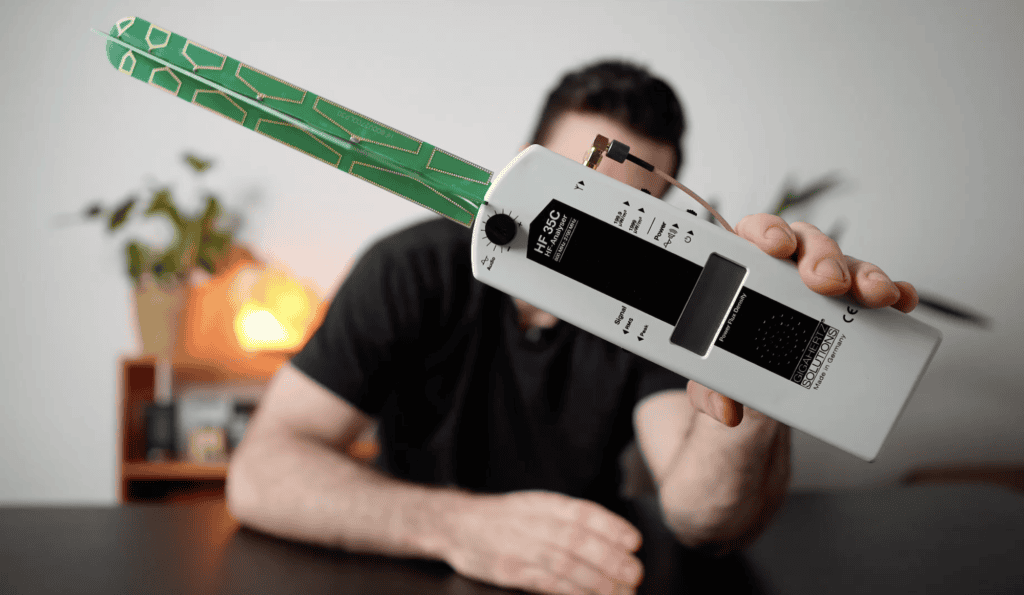
A person holds a white electromagnetic field (EMF) meter with a green circuit board antenna in front of their face, seated at a black table.

7 Best EMF Meters and Detectors 2026

*The information on EMF Academy is for educational purposes only and is not a substitute for professional medical advice. Please review our full Medical Disclaimer for more details. This post may contain affiliate links. Please see my disclosure to learn more.

I recommend EMF meters in many of the articles here on EMF Academy, and I do this for a very practical reason.

EMF meters are valuable tools that allow us to understand the presence and levels of electromagnetic fields (EMFs) in our homes, offices, or surroundings.

These devices provide insights into the EMF radiation emitted by household electronics and help identify sources of exposure.

If understanding the EMF exposures around you is important to you, then the best tool you can arm yourself with is a quality EMF meter that is accurate, simple to use, and measures all types of EMF radiation, including electric fields.

In this enormous guide, I will share with you what I think are the 7 best EMF meters you can purchase in 2026.

Don’t worry, though, I’m not going to leave you stranded. I’ll also thoroughly discuss why each meter was chosen, what its capabilities are, and why it might be a good fit for you.

Table of Contents

Let’s jump right into the reviews!

7 Best EMF Meters and Detectors of 2026

Each of the following EMF meters was chosen based on a variety of factors, including but not limited to:

  • Accuracy
  • Ability to measure all types of EMF radiation
  • Cost
  • User Friendliness
  • Features

Here is a table of the products I’m going to go over:

Best EMF Meters and Detectors of 2026

RankProductDetections Ease Of UseAccuracy
1.Trifield TF2 Absolute Best (I Use This One)RF/EF/MF5/54.5/5
2.GQ EMF-390RF/EF/MF3.5/54/5
3.HF35C RF Analyzer RF/EF/MF/5G3/55/5
4.Acoustimeter Very AccurateRF/EF/MF4/54.5/5
5.Cornet ED-88TRF/EF/MF4/54/5
6.Erickhill EMF Meter Best BudgetEF/MF5/53.5/5
7.Latnex HF-B3GRF/EF/MF4/54/5
This is a full list of the absolute best EMF and RF meters and detectors that you can buy in 2026. Ratings are based on my own testing and experience as well as thorough research.

You’ll notice that the meters are certainly not ranked just based on most and least expensive, which is for good reason.

For example, the Trifield TF2 is my number one recommendation but is much more affordable than, for example, the Acoustimeter AM-10.

Although the Acoustimeter is a fantastic device, I believe the Trifield delivers just about as good of a product at less than half the price.

These rankings are therefore a culmination of all of the factors listed above.

With that in mind, this list, although thoroughly researched and designed, is open to interpretation. I’d encourage you, if you disagree with my review or ranking, to let me know in the comments, or by contacting me and let me know your thoughts.

I was not gifted any of the devices I reviewed in this article, and I was not paid to write any of these reviews. My rankings and reviews are based entirely on my personal use of the products as well as my experience, research, and opinion.

A Word on 5G Detection: Most of the meters in this guide can detect low and mid-band 5G frequencies (the most common 5G you’ll encounter). If you need to detect ultra-high frequency mmWave 5G (20-40+ GHz), check out my complete guide to 5G radiation meters for specialized options.

With that mouthful out of the way, let’s talk about my first pick, the Trifield TF2.

1. Trifield TF2

Check the current price here.

If you’ve been around EMF Academy long, you know that I love to recommend the Trifield TF2, and I think it’s for a good reason.

The TF2 is Trifield’s follow-up to the wildly popular 100XE model that had an analog needle display, but similar functionality.

The TF2 brings some much-needed modernization to an already fantastic EMF meter.

I won’t go too in-depth about the product in this post, because I already wrote up a full review of Trifield TF2, however, I do want to give you a good understanding of why I love this EMF meter so much, and why it is the one I find myself using for just about everything.

Let’s start by talking about some of the features.

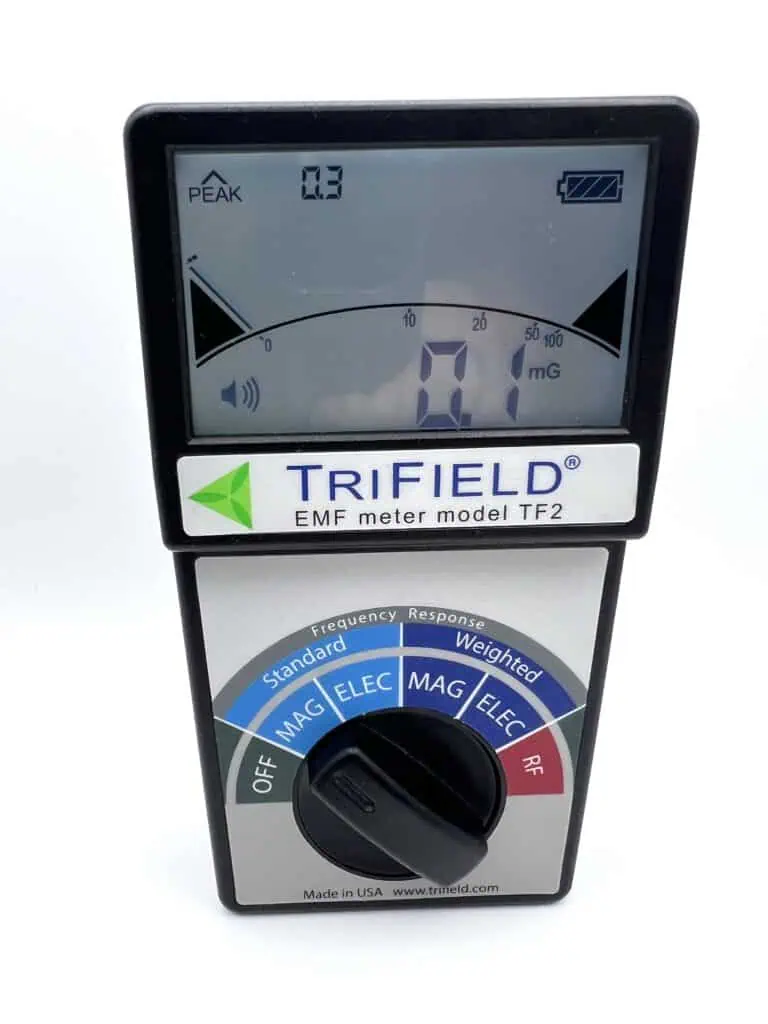
A Trifield EMF meter model TF2 displays readings on its digital screen, with a dial for selecting different modes.

Trifield TF2 Features

  • Can measure all three major types of EMF radiation, including Magnetic, Electric, and Radio Frequency/Microwave radiation
  • *New* weighted mode is specifically designed to measure EMF radiation in the human body.
  • The “Magnetic” setting uses a 3-axis sensor. This allows you to get accurate readings regardless of which way you’re pointing the meter.
  • Magnetic field strength measurements are crucial for detecting electromagnetic fields.
  • Brand new LCD offers much more information than the 100XE was able to, making testing a breeze.
  • Since there is a digital display, there is also a backlight that allows you to get readings even in low-light settings.
  • The TF2 now has an audio output to help you hear the EMF radiation around you. This can be extremely helpful for locating sources of radiation in your home.

The TriField TF2 measures RF radiation from 20 MHz to 6 GHz, which covers most common 5G frequencies (though not mmWave).

For most people assessing their home, this range is more than adequate for detecting WiFi, cell phones, smart meter radiation, and most 5G sources.

What Can You Measure With The Trifield TF2 EMF Meter?

  • Cell Phones
  • Tablets
  • Cell/Mobile Tower RF Radiation
  • Smart Meter Radio Frequency Radiation
  • WiFi Radiation from your router or other sources
  • Bluetooth Radiation
  • Radiation from Power lines
  • Laptop and desktop computer radiation
  • TV radiation
  • Home Appliance Radiation such as refrigerators and washing machines
  • EMF radiation inside of vehicles
  • Find the location of EMF radiation coming from your wiring via dirty electricity
  • EV charger EMF radiation (both while charging and idle)
  • WiFi 6 and WiFi 6E router radiation
  • 5G phones and most 5G cell towers (sub-6GHz bands)
  • …And anything else that emits EMF radiation

Ok, now let’s walk over some of the pros and cons, of the Trifield TF2

Pros Of The Trifield TF2

Trifield EMF meter model TF2 with a digital display and a dial showing options for magnetic, electric, and radio frequency measurements.
  1. The Display – I love the display of the Trifield TF2 more than any of the other EMF meters on the market. It provides an enormous amount of information in a way that is simple to find and easy to understand.
  2. The Price – The TF2 is very competitively priced, and honestly is an absolute bargain for what you get. Trifield meters are famous for their construction quality, so expect not to have to replace this meter anytime soon.
  3. User-Friendly – Whether you are an expert on EMF radiation (perhaps you’ve read all the content on EMF Academy 🙂 ), or you’re just starting out, the Trifield works well for both.

    Trifield meters have long been popular because they are very simple to operate, making them great for beginners, but also have the accuracy and functionality that professionals are looking for.

    I think with the added LCD, and “peak” indicator, the TF2 is an even easier unit to operate.
  4. Audio – One of my absolute favorite additions of the Trifield TF2 is the audio output. Although if you’re trying to determine actual EMF radiation levels of certain things, you will want the field indicator, if you are just trying to move around your home and locate EMF radiation sources, the audio is fantastic.

    Using the audio, you don’t even need to look at the display. Also, since the TF2 is a tri-axis EMF meter, directionality doesn’t matter for the display, or for the audio output.
  5. Measures All EMFs – The TF2 measures magnetic field, electric field, AND radio frequency radiation (20 MHz – 6 GHz). This tri-mode capability means you can test everything from power line EMF to your WiFi router with one device.
Close-up of a Trifield device with an open battery compartment, showing the screen light and audio buttons.

Cons Of The Trifield TF2

  1. Audio And Backlight Buttons – I found it a bit frustrating that both of these buttons can only be accessed by removing the battery cover. You can see the little green buttons in the picture I took.

    I think they were trying to maintain a slick and simple look by only having the dial on the front of the unit, however, I wish that they had made these two buttons easier to access.
  2. Weighted Mode – For a professional user, having a weighted mode is handy. However, for the average person using the Trifield TF2 to measure EMF radiation in their home or office, this option might be a bit confusing. (Pro-tip: just ignore the weighted mode unless you know a reason you need it.)

Technical Specifications

I don’t want to bore you with all of the specs, if you’re curious about them head over to my full TF2 review, I’ll just give you a few important highlights.

AC Magnetic Mode
Frequency range 40Hz – 100KHz
3 – axis

AC Electric Mode
Frequency Range: 40 Hz – 100 KHz
1-axis

Radio Frequency Radiation Mode
Frequency Range: 20 MHz – 6 GHz
1 – axis

TF2 Battery Life
9V alkaline battery included
Battery life with backlight off > 20 hrs
Battery life backlight on > 12 hrs

How the TF2 Handles 5G
The TriField TF2’s RF range of 20 MHz to 6 GHz covers:
– ✅ Low-band 5G (600-900 MHz)
– ✅ Mid-band 5G (2.5-3.7 GHz, including C-band)
– ❌ mmWave 5G (24-40+ GHz) – requires specialized meters. If you specifically need to detect mmWave 5G, see my 5G radiation meters guide

In this video, I walk you through exactly how to use a Trifield TF2 to measure EMF radiation in your home or office:

Final Thoughts On The Trifield TF2

I wouldn’t rate the Trifield TF2 as my top pick in 2026 if I didn’t truly believe in the product. I’ve used many EMF meters, and I always find myself going back to the Trifield.

The price is extremely reasonable, and you honestly will love how accurate and simple to operate this device is. There are other great EMF meters on the market that we’ll talk about next, but this is my #1 choice.

2. GQ EMF-390 EMF/RF Meter

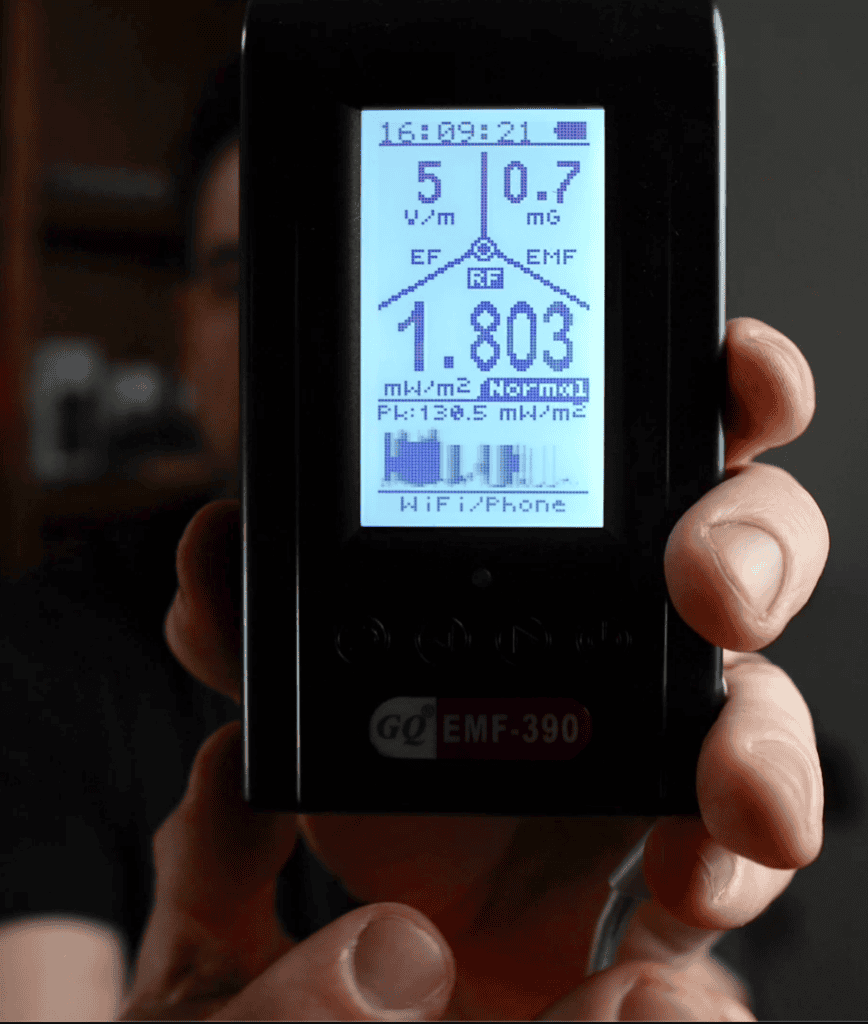
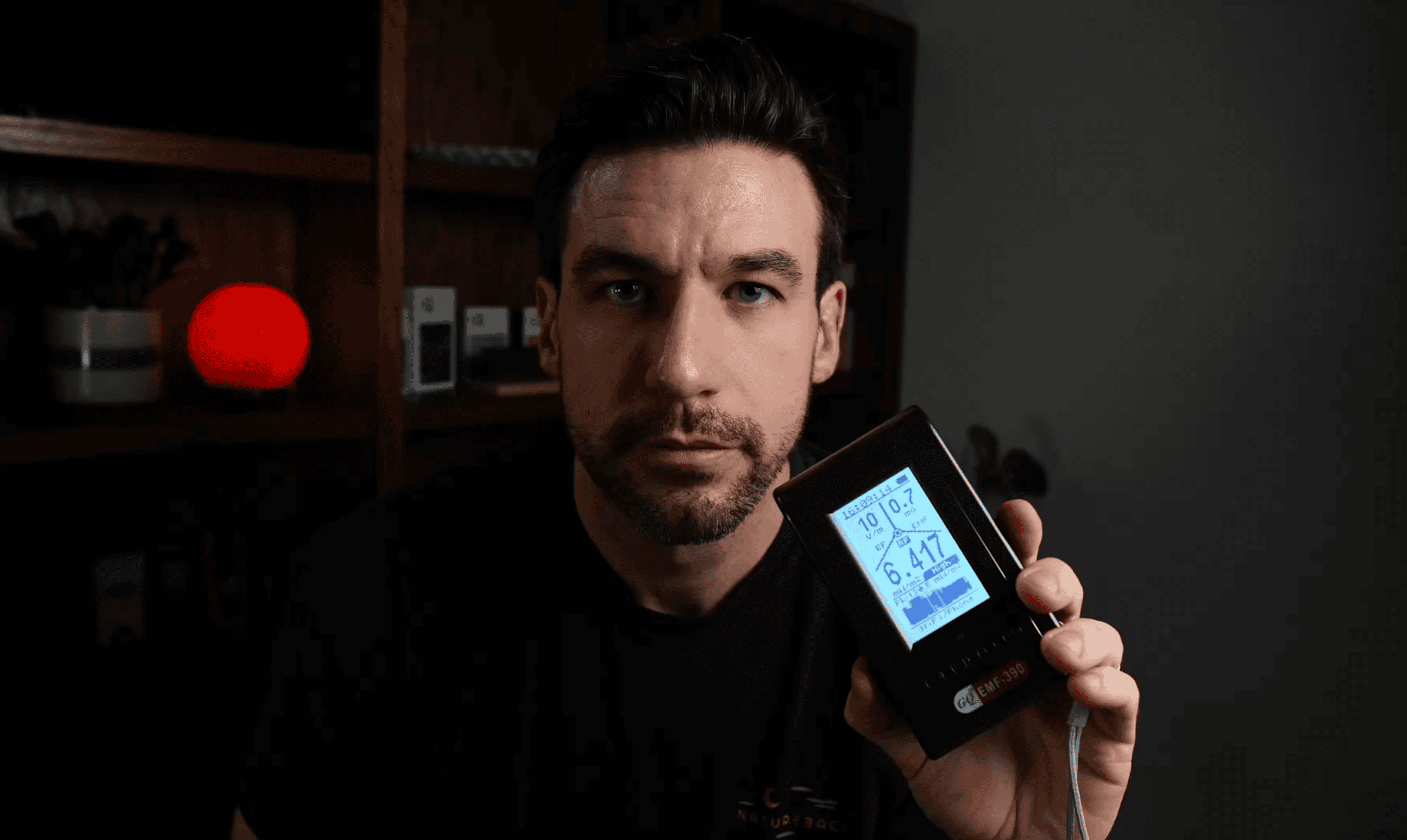
A person holds an EMF-390 electromagnetic field meter displaying radiation readings and measurements on its screen.
Image taken during review of the GQ EMF 390

Check the current price here.

Updates in 2026: The GQ EMF-390 has quietly become one of the best values in EMF meters. It offers professional-level features (data logging, PC software, simultaneous readings) at nearly half the price of comparable meters. This has quickly become one of my favorite and most used EMF Meters

The main reason that it has become so popular is the sheer amount of data that it can display while it’s taking readings.

It can also store that data with its built-in flash memory. You can display all that data later and download it to your computer using free software.

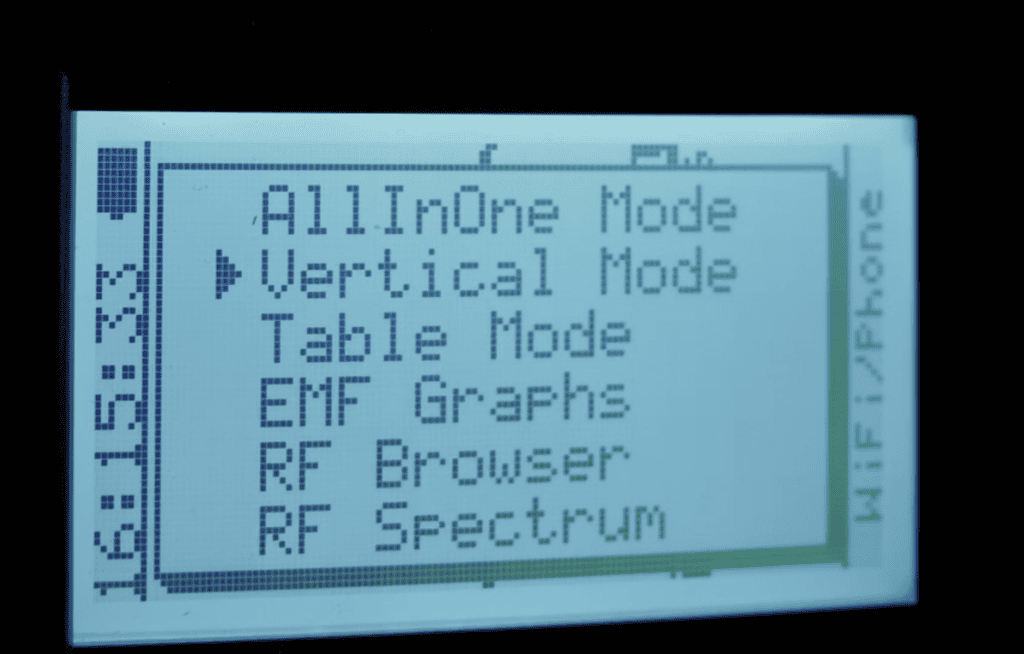
Close-up of an LCD screen displaying a menu with options: AllInOne Mode, Vertical Mode, Table Mode, EMF Graphs, RF Browser, and RF Spectrum.
GQ EMF 390 Modes

One of the coolest parts of the GQ meter is that it can actually display all three readings at one. You can literally get magnetic field, electric field, and radiofrequency readings displayed all at the same time.

One of the popular features of the meter is the “safety suggestion” which will display the danger based on current readings. This is great for people who don’t have a good idea of what a dangerous EMF reading is and are for instance checking out new homes.

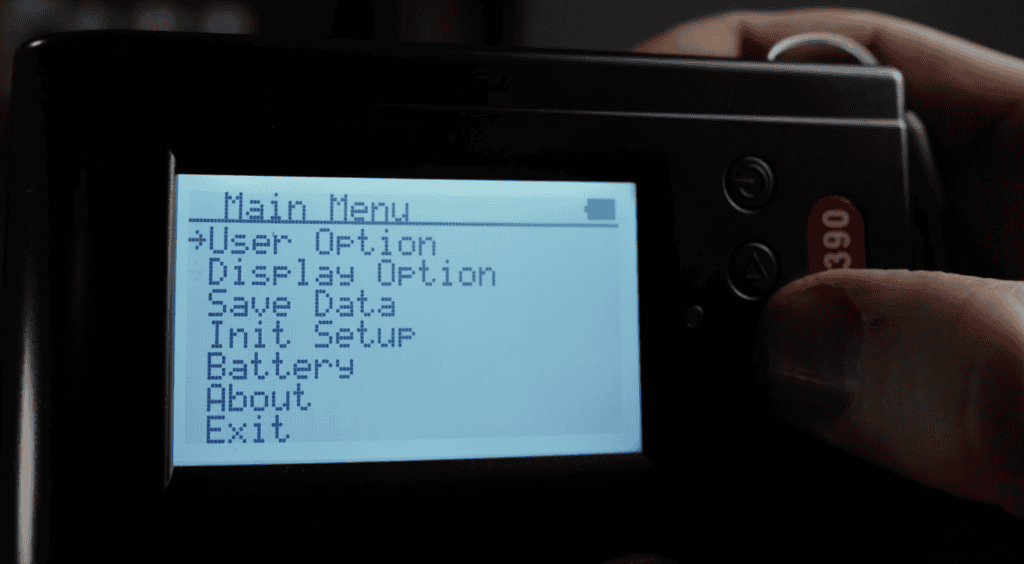
Close-up of a device screen showing a main menu with options like User Option, Display Option, Save Data, Init. Setup, Battery, About, and Exit. A hand is holding the device.
GQ EMF 390 Menu Options

You can of course also turn it to a more classic mode for each type of reading which will just display more information specific to that type of EMF.

If you love data, then this might be the EMF meter for you. It can do really cool things like track multiple RF radiation sources at the same time.

I can’t cover all the features of this meter in a single review, but I’ll just say that I’m glad I have it in my toolkit, and I think it will continue to be a really popular EMF meter for years to come.

If you want to see this EMF meter in action, here is a video of me reviewing and showing my favorite features of the GQ EMF 390

GQ EMF-390 vs. Trifield TF2: Quick Comparison

Many people ask which meter to choose between these two. Here’s my take:

Choose the TF2 if: You want the most trusted brand, simplest operation, and don’t need data logging –

Choose the GQ EMF-390 if: You want to save a little money, love data/graphs, and want to track readings over time, both are excellent meters. The TF2 is more intuitive, while the GQ offers more features for less money.

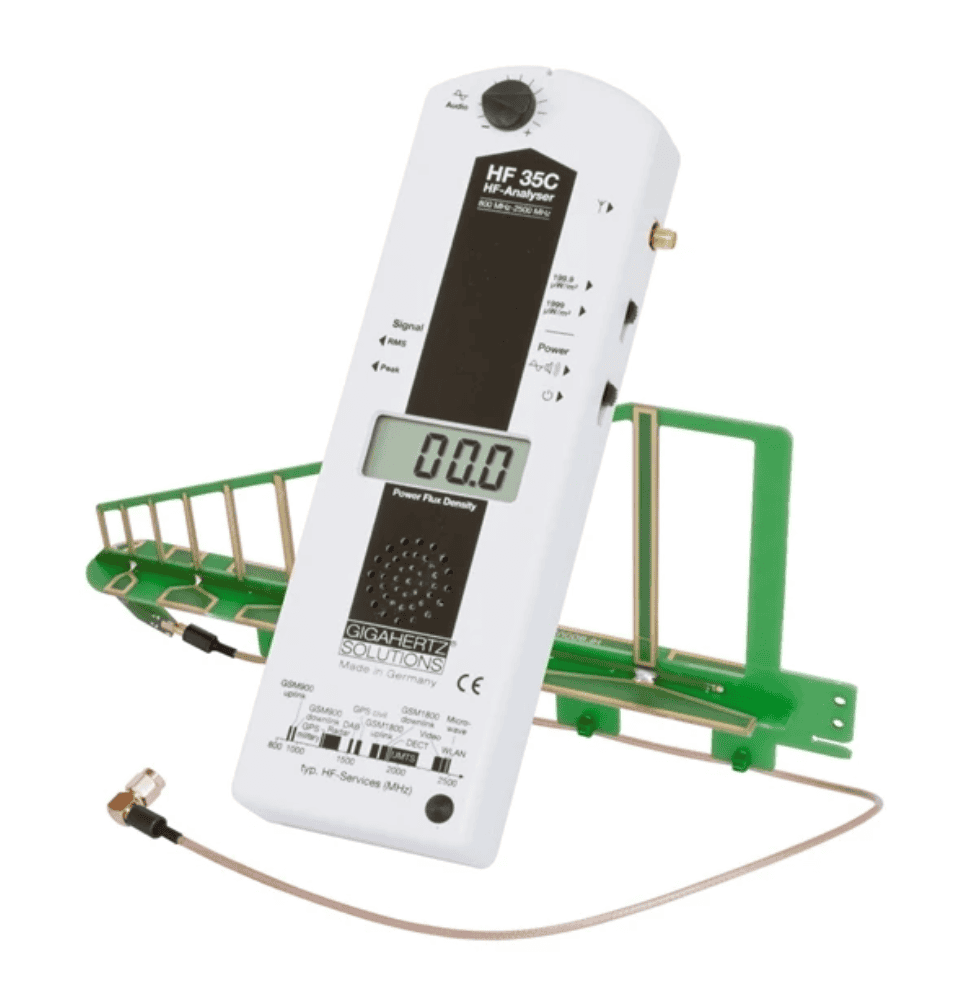
3. HF35C RF Analyzer by Gigahertz Solutions – Professional Grade

Check current price on Amazon

The HF35C is different from every other meter on this list.

It’s not trying to be an all-in-one device. It doesn’t even measure magnetic fields or electric fields. It does one thing really well: measures radio frequency radiation with a high level of accuracy

Who Is This Meter For?

The HF35C is for people who need precision RF detection, and who want to be able to pintpoint the direction and source of that radiation.

A person holds a white electromagnetic field (EMF) meter with a green circuit board antenna in front of their face, seated at a black table.
Testing the HF35C

If you just want to test your home for general EMF levels, get the Trifield TF2. It measures all three types of EMF radiation for less money.

But if you need to know where that RF signal is coming from, or need professional-level accuracy than I think the HF35C is worth it.

Before I get into the technical specifications, feel free to check out my quick Youtube overview of the HF35C:

HF35C Technical Specifications

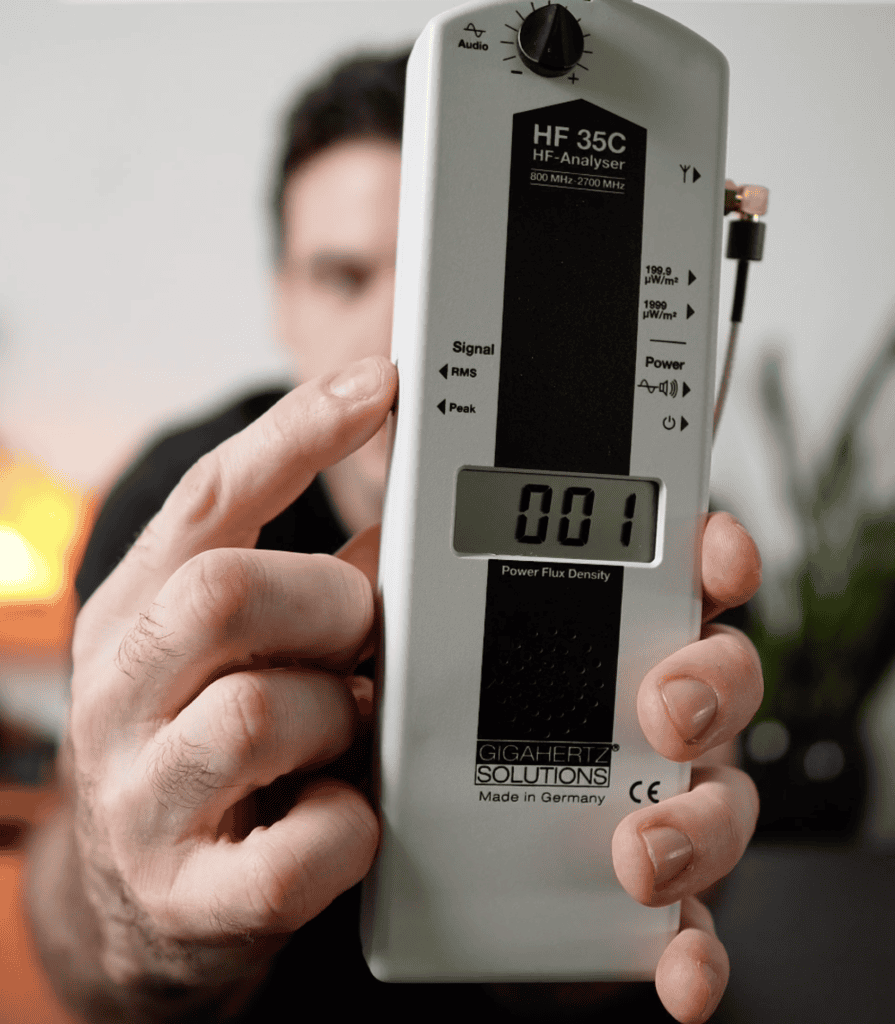
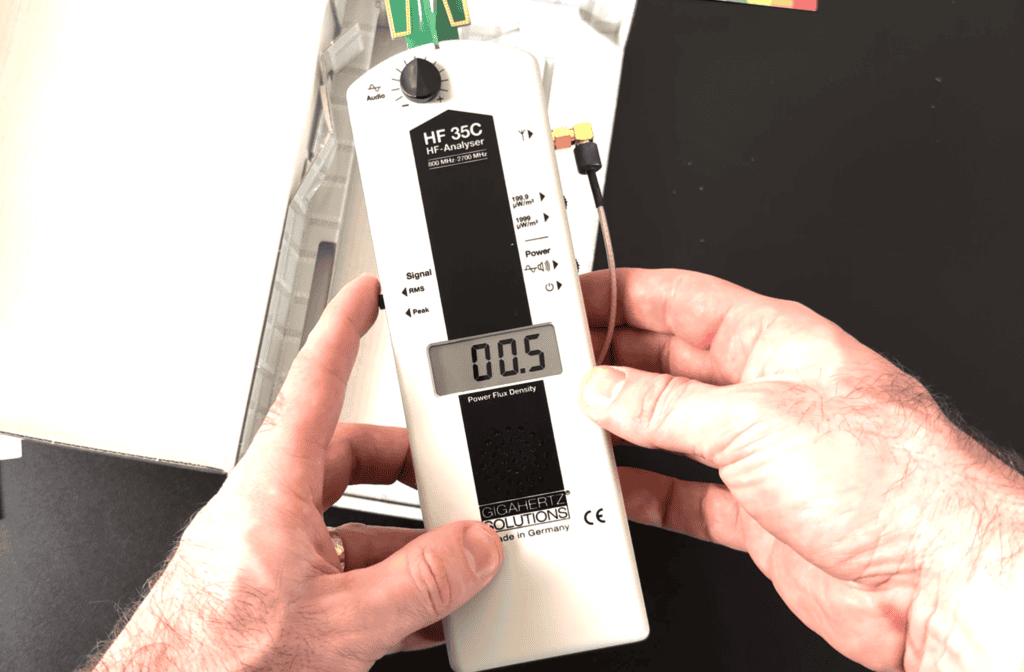
A person holds and points at an HF-35C HF-Analyser device displaying 001 on its screen, with controls labeled Signal, Power, and Peak.

Frequency Range: 800 MHz to 2.7 GHz

  • Covers: Cell phones, WiFi routers, smart meters, cordless phones, wireless security cameras, baby monitors
  • Does NOT cover: Low-band 5G below 800 MHz, mmWave 5G above 2.7 GHz, or ultra-low RF below 800 MHz

Measurement Capabilities:

  • Two sensitivity ranges: 0.1-199.9 µW/m² (fine) and 1-1999 µW/m² (coarse)
  • Peak AND RMS measurement modes
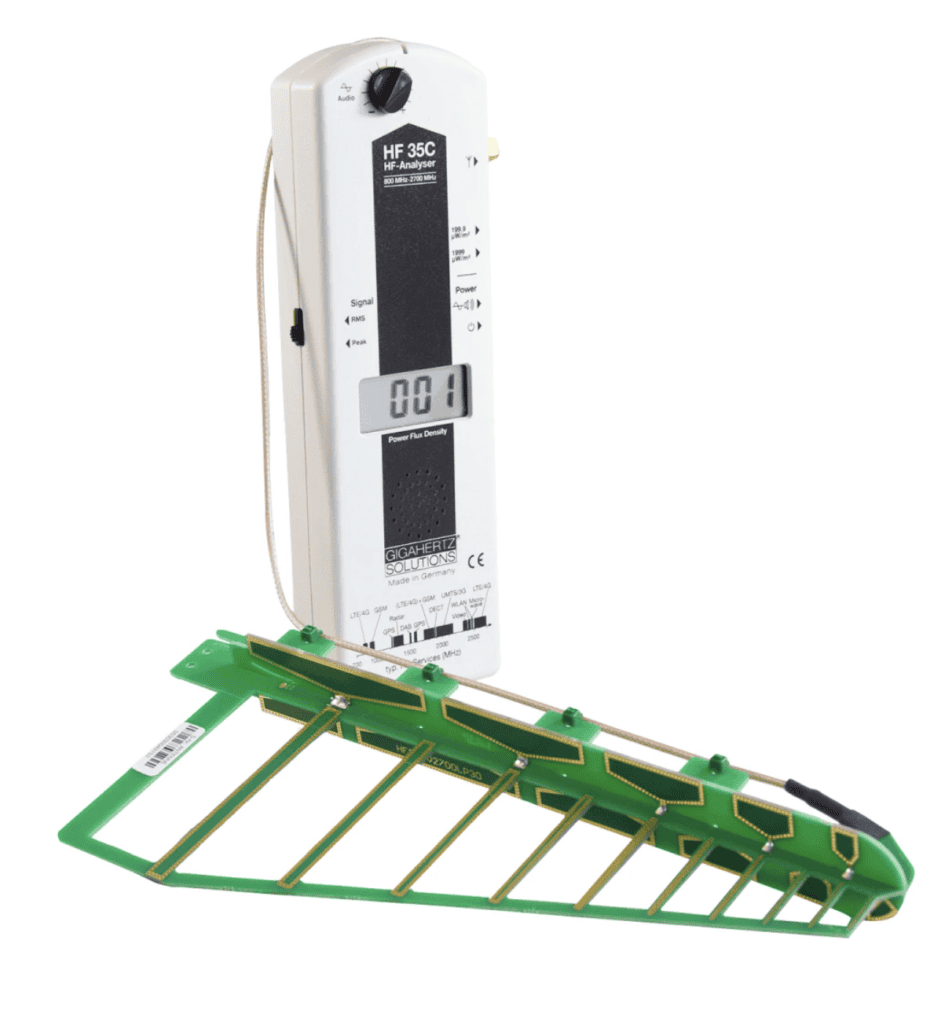
  • Logarithmic-periodic directional antenna
  • 6 dB accuracy across 9 digits
  • Real-time audio analysis
Unique Features
White handheld RF meter with digital display and attached green/yellow directional antenna, used for measuring high-frequency electromagnetic fields.

1. Directional Antenna
The HF35C’s logarithmic-periodic antenna is directional, meaning it picks up stronger signals from whatever direction you point it. This is incredibly helpful for pinpointing sources.

Example: You’re getting high RF readings in your bedroom. With the HF35C, you can sweep it in a circle and watch the readings spike when you point it toward your neighbor’s WiFi router on the other side of the wall. Then you know exactly where to focus your shielding efforts.

2. Dual Measurement Modes (Peak + RMS)

  • Peak mode: Shows the highest momentary burst (useful for pulsed signals like WiFi)
  • RMS mode: Shows the average over time (useful for continuous signals)

Most consumer meters only show one or the other. The HF35C shows both, giving you a complete picture.

3. Audio Feedback
Plug in headphones (or just use the built-in speaker) and the HF35C translates RF radiation into sound. Different frequencies sound different, which helps you identify sources:

  • WiFi routers have a distinct buzzing pattern
  • Cell phones have a pulsing rhythm
  • Smart meters emit periodic bursts

This is genuinely useful, not just a gimmick.

A person holds an HF-35C RF analyzer showing a power flux density reading of 0.5 on its digital display.

Pros of the HF35C

  1. Exceptional RF Accuracy – Very accurate at reading RF, especially at the price.
  2. Directional Detection – Actually helps you pinpoint sources, not just detect them
  3. Battery Life – 6-7 hours of continuous use
  4. Professional Reputation – I happen to know that this is what many EMF consultants use
  5. Audio Analysis – I use this feature often.

Cons of the HF35C

  1. RF Only – You’ll need a separate meter for magnetic field and electric field measurements
  2. Limited Frequency Range – 800 MHz to 2.7 GHz misses low-band 5G and mmWave
  3. Learning Curve – Not super beginner-friendly; requires some understanding of RF concepts

Where to Buy the HF35C

The HF35C is available from several specialty retailers:

4. Acoustimeter AM-10 RF Meter

Check out the Amazon listing here.
The Acoustimeter is probably without a doubt the best Radio Frequency (RF) meter on the market. It is extremely accurate, simple to use, and preferred by professionals.

However, it does have its downsides. For example, it only reads RF radiation and is not designed to read electric field or magnetic field radiation.

We’ll talk more about the positives and negatives of the Acoustimeter in a second, I just want to say that if you are looking strictly for an RF meter, this is the one you need.

There is a reason that you will see the Acoustimeter AM-10 in the hands of so many professionals, it is extremely accurate and simple to use.

Let’s talk a little bit about why this might be a great meter for you.

Things I Love About The Acoustimeter AM-10

Sensitivity – To start with, the Acoustimeter is one of the most sensitive RF meters on the market, capable of reading even the smallest amounts, of the lowest radio frequencies and displaying them.

Not only that, but it also has fantastic directional sensitivity. This will allow you to easily locate the direction that the largest RF radiation sources are coming from by simply moving your Acoustimeter in a circle and watching the display to see peak readings.

I have a great guide on how to see a map of every cell tower near your home. You’ll find that if you pull that map up, and locate the nearest cell tower, your Acoustimeter should show the highest readings when pointed towards it.

This demonstrates the Acoustimeter’s ability to help you locate dangerous sources of radiofrequency radiation. You are also likely going to be able to locate things like your neighbor’s WiFI router, that is how sensitive the Acoustimeter can be.

Frequency Range – The next thing I like about the Acoustimeter is the enormous frequency range that it can measure. For example, the Trifield TF2 is capable of reading up to 6Ghz (which for now is probably plenty). But if you’re interested in detecting the much higher millimeter wave frequencies used in high-band 5G (20–40+ GHz), you’ll want to read my guide to the best 5G EMF meters that are designed specifically for that.”

Ease Of Use – Next, the Acoustimeter is simple to use. There is a simple display at the top, as well as two rows of LED lights below. When using the meter, I like to plug a pair of headphones into the audio jack (with or without the headphones) and use the audio to help me locate sources of RF radiation.

Once I hear some noise and know that there is RF radiation nearby, I primarily look at the lefthand row of LEDs, which shows the peak V/m readings.

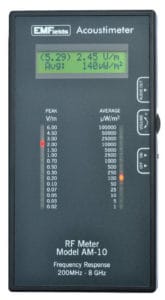
LCD screen displaying data: (5.29) 2.45 V/m and Avg: 140 µW/m².

Then once I see a spike in RF radiation from the lights, I’ll check the small LCD screen at the top to get accurate readings. If you take a look at the small screen to the right, you can see what will typically be displayed. Here is how you would read this screen:

  • The 5.29 in brackets shows you the “peak hold” reading in V/m, which is the highest reading that has been recorded since you turned the Acoustimeter on.
  • The 2.45 is the current peak signal strength measured in V/m, which will correspond to that left row of lights.
  • The 140 µW/m2 is the average reading measured in microwatts per square meter and will correspond to the right row of lights.

Overall I find the Acoustimeter easy to use, especially once you get used to it.

Things I Don’t Like About The Acoustimeter

Cost – First of all, it is a fairly expensive device relative to its features. At more than double the price of the TF2 (at the time of this writing), you certainly want to make sure this is the device for you before purchasing.

I’m not saying that it isn’t worth the price, because honestly for the right person, it is. Just understand that you are paying for the accuracy and quality of the machine, not for bloated features.

Size – Next, the device is relatively bulky. I’m hoping that future models are designed a little bit slimmer and sleeker.

Limitation – It is unfortunate that the Acoustimeter only measures RF radiation, and not magnetic or electric. This is intended, as this meter is entirely focused on being a top-of-the-line radio frequency meter, however, it means that to measure all forms of EMF radiation you’ll need more than one meter.

Final Thoughts On The Acoustimeter

Overall I think the Acoustimeter is a fantastic device and the best Radio Frequency meter on the market in my opinion. It’s simple to use, extremely accurate, and a very sturdy device that should last a very long time.

5. Cornet ED88T EMF Meter

Check out the Amazon listing here.

Update for 2026: The Cornet ED88TPlus (and ED88TPlus5G variant) has become one of the most popular meters for those specifically concerned about 5G radiation. Its extended frequency range up to 8 GHz covers mid-band 5G including the C-band spectrum (3.5 GHz) that carriers rolled out in 2025-2026.”

Other than the Trifield TF2, the Cornet ED88T might be one of the most popular EMF meters on the market. In terms of features and price, it’s quite similar to the TF2, but there are a few reasons I’ve ranked it a bit lower.

All in all, it’s a quality meter by a great company that I don’t think you’ll be disappointed with.

Let’s jump right into talking about some of the things I like and don’t like about the Cornet ED88T.

Things I Like About The Cornet ED88T

Measure All EMF Radiation – First of all, just like any great EMF meter, the Cornet ED88T performs comprehensive EMF measurements, covering all three types of EMF radiation, including radio frequency, magnetic field, and electric field.

This, in my opinion, is one of the most important features of a good EMF meter, as you’ll want to know the measurements of all three when measuring your home or office.

Frequency Readings – One of the reasons that many people purchase the Cornet ED88T is that it not only gives you a reading of the RF radiation in terms of signal strength like the Acoustimeter did, but will also show you the actual frequency that it is picking up in a range of 100 Mhz to 2.7 GHz. This is an extremely helpful

5G Detection Capability – The Cornet’s 100 MHz to 8 GHz range makes it one of the best EMF meters for 5G detection. It covers low-band 5G (600-900 MHz), mid-band 5G (2.5-3.7 GHz), and even some higher frequencies. The ultra-fast sampling rate (25,000 samples/second for the Plus5G model) can capture the quick RF bursts that 5G towers emit.

Radio Frequency Sensitivity – Other than the Acoustimeter, the Cornet ED88T is probably the next best meter for detecting Radio Frequency radiation. It has a similar range of 100MHz – 8GHz and appears to be extremely accurate. This is partly due to its extremely fast sampling rate of 10,000 samples/sec.

Sound Feature I like that the Cornet does feature a sound output for Radio Frequency radiation readings, which I find extremely helpful when measuring radiation in a space like a home or an office.

Reading History – This is one of my favorite features of the Cornet. While you’re using the meter, it displays the last 30 readings, so you can look back and find spikes after scanning a room or a home. This can be especially helpful for getting readings from things that tend to pulsate, such as Smart Meters.

Smart meters usually have extremely high spikes or radiation when transmitting information, however, this occurs very quickly and it can be hard to get an accurate reading. With the Histogram feature, this is a piece of cake and you can easily look back at the reading.

Ok, now let’s talk a little bit about some of the things I don’t love about the Cornet ED88T.

Cons Of The Cornet ED88T

User Friendliness – I don’t personally feel like the Cornet ED88T is all that user-friendly. There are only a few buttons, which you would think would be a good thing, but it is not clear what they do, and I found that when first using the device I was stumbling around a bit. In contrast, I found the Trifield TF2 to be almost impossible to use incorrectly, as you simply turn the large dial on the front to what you want to measure, and off you go.

I also felt like the user manual that comes with the Cornet ED88T was not all that helpful in showing you how to properly navigate the device.

Units of Measurement – I prefer to read magnetic fields in milliGauss, however, the primary reading number of the device is in Tesla (it does show the mG, however, it’s the smaller number below the larger Tesla number). This also can’t be changed, you’ll always be looking at the smaller number to find the milliGauss. All of the other units of measurement displays can be changed in the settings luckily.

Final Thoughts On The Cornet ED88T

The Cornet ED88T is a very popular meter and is preferred by many professionals over meters and detectors like the Trifield TF2. It does have some unique functionality, like reading the frequency range of Radio Frequency.

I personally don’t find it as user-friendly as the TF2, but it is an extremely high-quality meter with very similar functionality. I certainly don’t think you’ll go wrong if you purchase the Cornet ED88T.

6. Erickhill RT100S – Best Budget Option

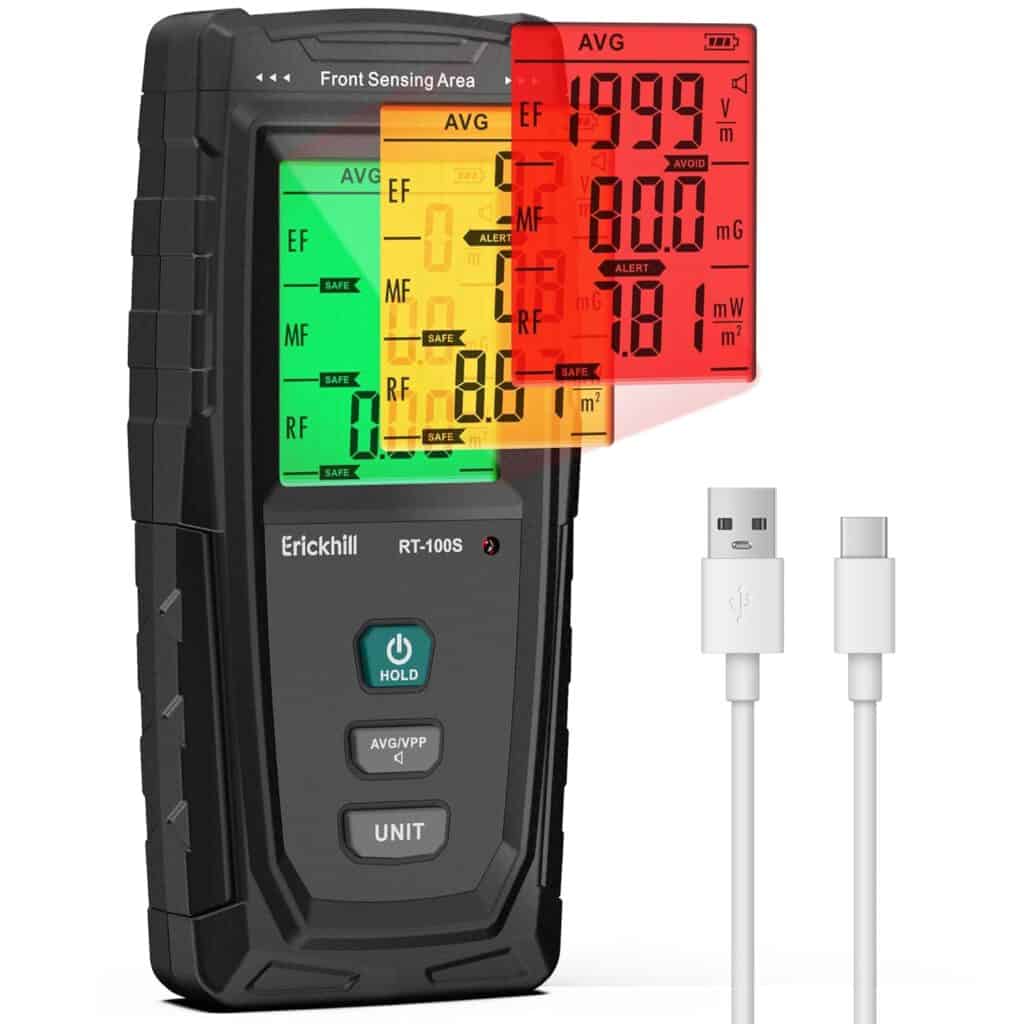
A digital EMF meter with a color LCD display showing different readings, next to a USB charging cable. The screen displays green, yellow, and red warning levels.

Check out the current price on Amazon.

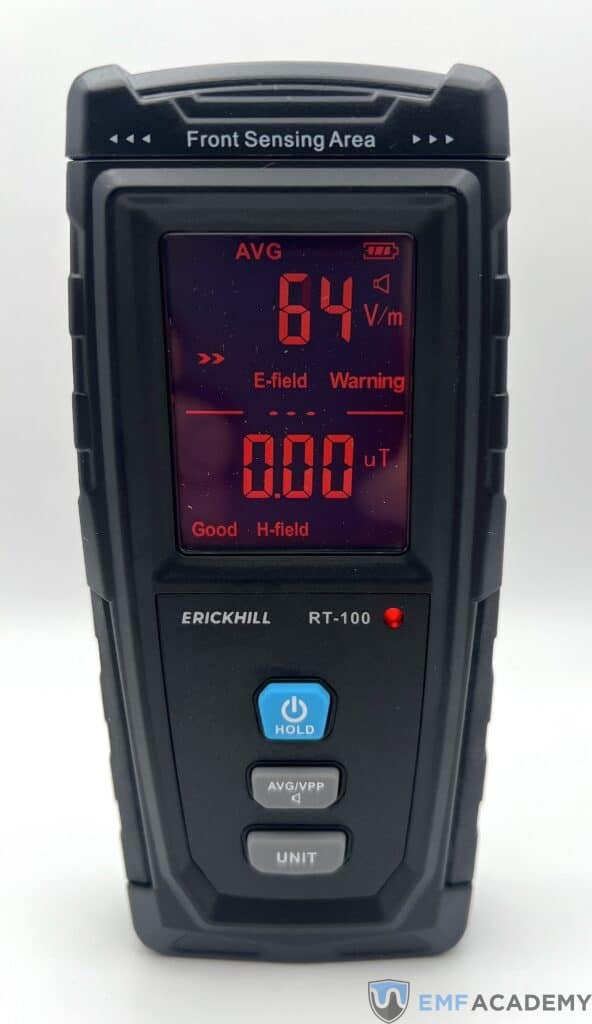
The Erickhill RT-100S is fairly new to my top EMF detector list, but it’s quickly taken the spot as the best budget meter that measures all three types of EMF radiation, and let me tell you why.

First of all, this meter packs a ton of features and ease of use at a really low price.

You of course are sacrificing some accuracy and range that you’d get with something like the Trifield TF2, but you can’t expect to get everything at a buget price.

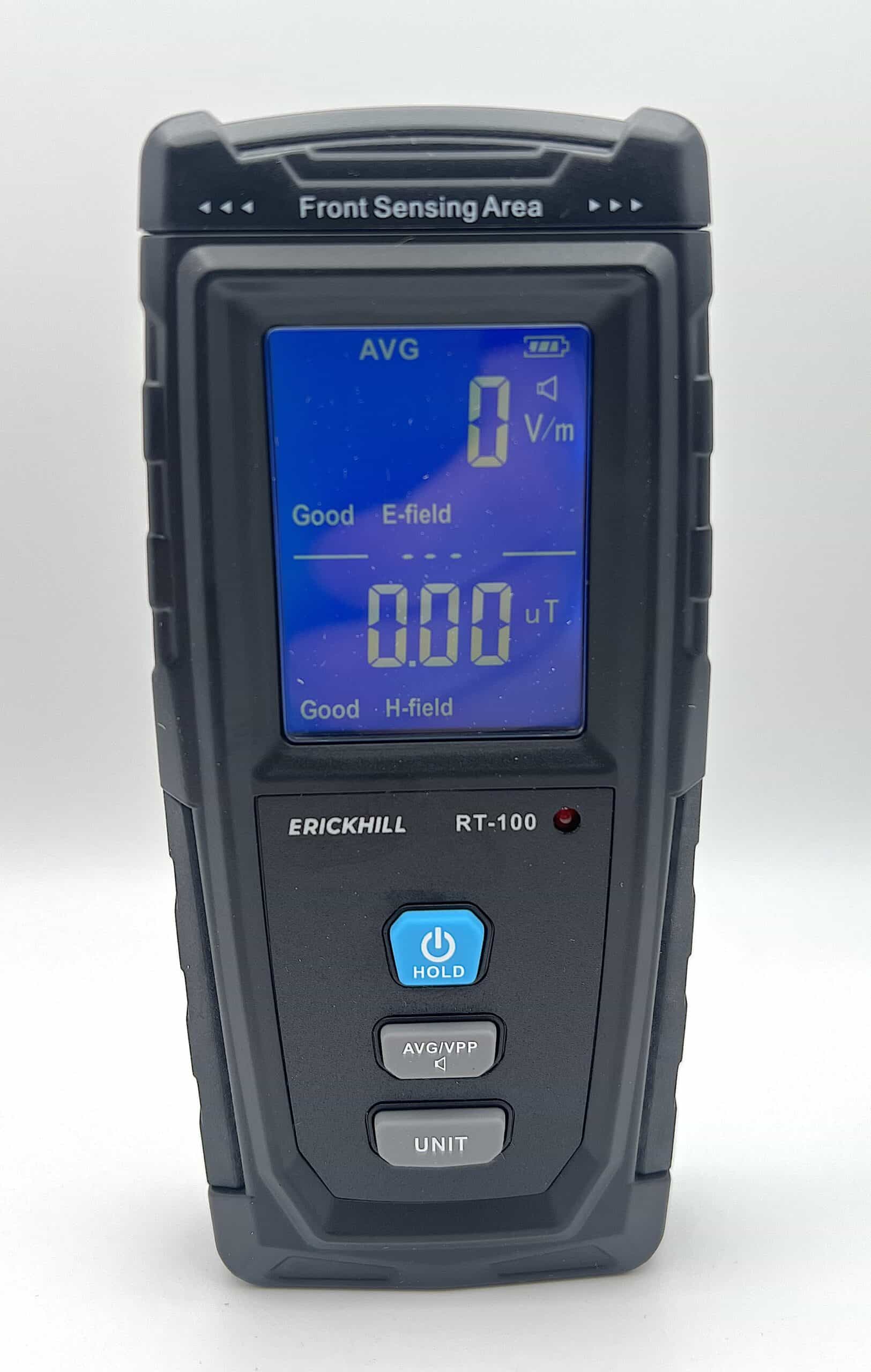
A digital electromagnetic field meter with a blue display showing measurements for electric and magnetic fields. The device is made by Erickhill and is model RT-100

Let’s go over some of the pros and cons I found:

Pros of the ERICKHILL RT-100S

All Three EMF Types: Unlike most budget meters that only read magnetic and electric fields, the RT-100S also measures radio frequency radiation. This means you can test WiFi routers, cell phones, and other RF sources. This is pretty incredible at a budget friendly price.

Simultaneous Display: This is probably my favorite feature. All three readings (electric, magnetic, and RF) show on screen at the same time. You don’t have to switch modes or toggle between readings. You can see everything at once. Really convenient.

Rechargeable: The RT-100S has a built-in rechargeable battery with Type-C charging. No need to keep buying 9V batteries like with many other meters. Battery lasts about 8 hours, which is plenty for home testing.

Color-Coded Display: The display changes color based on radiation levels: green (safe), orange (caution), red (move away). Makes it super easy to understand readings at a glance without needing to know what the numbers mean.

Usability: I can tell you that it is very user-friendly and extremely easy to navigate. The display is clear with both digital numbers and bar graphs. It has built-in alarms (you can turn the sound off if you want) that alert you to high EMF readings.

Cons of the ERICKHILL RT-100S

Erickhill EMF meter flashing red and alarm sounding.
Erickhill EMF meter flashing red and alarm sounding

RF Range Limitations: Although this meter measures RF radiation (which is great for the price), it can’t detect 5 GHz WiFi frequencies. If you have a modern WiFi 6 or WiFi 6E router, you’re missing some of the RF emissions. It also won’t detect ultra-high 5G mmWave. For most people this won’t matter much.

Accuracy Trade-offs: Like all budget combination meters, the RT-100S sacrifices some accuracy to measure multiple EMF types. It’s great for identifying hotspots and high-exposure areas, but don’t expect lab-grade precision. If you need professional accuracy, you’ll want the Trifield TF2 or higher.

Single Axis: The RT-100S is a single-axis meter, so you need to point it directly at whatever you’re measuring to get accurate readings. This is typical for budget meters, but worth noting.

Screen Visibility: Some users report the screen can be hard to read in bright sunlight. Not a dealbreaker, but something to be aware of.

Final Thoughts on the ERICKHILL RT-100S

Overall, I the Erickhill is the best budget meter available in 2026 if you want to measure all three types of EMF radiation. The combination of low price, RF capability, simultaneous display, and rechargeable battery make this a fantastic beginner option.

The big upgrade here over other budget meters is the RF detection. Most budget meters only measure magnetic and electric fields, this one adds radio frequency, which means you can actually test your WiFi router, cell phone, and smart meter.

Who should buy this: If you’re just starting out with EMF measurement, want to test your home without wanting to spend as much as a Trifield, and want the convenience of seeing all three EMF types at once, the RT-100S is a solid choice.

Who should skip this: If you need professional accuracy, want to detect all WiFi frequencies including 5 GHz, or are doing serious EMF remediation work, invest in the Trifield TF2 instead. The RT-100S is great for awareness and identifying problem areas, but it’s not a professional tool.

7. Latnex HF-B3G Radio Frequency Meter

Check out the Amazon listing here.

The Latnex is a great radio frequency meter and is sort of a budget version of the Acoustimeter.

Offering only radiofrequency radiation detection, the Latnex does not offer a full range of detection but does some great quality for a reasonable price.

I’ll just interject here, that in my honest opinion, I don’t think there is much reason to purchase the Latnex over the Trifield TF2, considering the similar price, and extra features you get with the Trifield.

Let’s take a look at some of the features I like about the Latnex HF-B3G.

Latnex EMF Meter Pros

Triple-Axis – The Latnex does have a triple-axis radio frequency detector (the ball on the top of the device) which allows you to get accurate readings regardless of the orientation of the device.

Great Manual – The Latnex comes with a very detailed user manual (see that here) that really comes in handy. I find the manual to be even more thorough than the manuals that come with some of the higher-quality meters.

Easy To Use – With a simple display and 7 nicely labeled buttons, the Latnex is a breeze to operate.

Latnex EMF Meter Cons

Only RF Readings – Obviously the largest downside of the Latnex is simply the fact that it only reads RF radiation. Like the Acoustimeter, this is how the device is designed, but it is certainly nice when the meter measures all types of Radiation like the Cornet or the Trifield TF2.

Quality – Latnex, although they make a variety of EMF meters including ones that measure magnetic field radiation, it has not been around as long as some of the other companies. This makes me doubt the reliability a little bit since it has not stood the test of time.

Final Thoughts

The Latnex is a great radio frequency meter with great reviews. However, I’d encourage you to look at some of the other options. If you want a high-quality RF meter, go with the Acoustimeter.

If you want a reasonable price EMF meter that still has great RF functionality, go with the Cornet or the Trifield. That is just my honest opinion and suggestion.

Quick Comparison Chart: All 8 Meters at a Glance

Still trying to decide? Here’s how the meters stack up:

By What You Can Measure

All Three EMF Types (RF + Magnetic + Electric):

  1. Trifield TF2 – Best overall
  2. GQ EMF-390 – Best value
  3. Cornet ED88TPlus – Best for 5G
  4. Latnex AF-5000 – Best display

RF + Either Magnetic OR Electric:

  • Erickhill – Magnetic + Electric (no RF)

RF Only (Specialists):

  • Acoustimeter AM-10 – Easiest professional RF meter
  • HF35C – Most precise RF detection
  • Latnex HF-B3G – Budget RF meter

By 5G Detection Capability

Best 5G Detection (up to 8 GHz):

  1. Cornet ED88TPlus5G – Specifically designed for 5G, covers C-band
  2. GQ EMF-390 – 10 MHz to 8 GHz range
  3. Acoustimeter AM-10 – 200 MHz to 8 GHz

Good 5G Detection (up to 6 GHz):

  • Trifield TF2 – Covers low and mid-band 5G (most common)

Limited 5G Detection:

  • HF35C – 800 MHz to 2.7 GHz (misses higher 5G bands)
  • Latnex HF-B3G – 50 MHz to 3.5 GHz

Note: None of these meters detect mmWave 5G (20-40+ GHz). For that, see my 5G radiation meters guide.

Ok, now that we’ve made it through our list of the Best EMF Meters,, let’s talk a little bit about the reasons you might want to get an EMF meter in the first place, and why it is such a valuable tool.

What About 5G EMF Meters?

As 5G continues to roll out, especially the high-band millimeter wave (mmWave) stuff you’ll find in big cities and crowded areas, I’ve been getting a lot of questions like:
“Can my EMF meter actually detect 5G?”

The short answer is: it depends.

Most of the meters I’ve talked about in this guide (including the Trifield TF2, Cornet ED88T, and GQ EMF-390) can detect the low and mid-band 5G frequencies. That includes most 5G towers and devices you’d run into in a typical neighborhood or home.

But none of these can pick up the ultra-high frequency mmWave signals that are part of the fastest versions of 5G. For that, you’ll need a specialized meter — something like the Safe and Sound Pro mmWave, which is built specifically to detect those frequencies.

If you want to dive deeper and see which meters can actually measure 5G radiation (especially mmWave), I put together a full guide on that.

Check out my complete guide to the Best 5G EMF Meters here: https://emfacademy.com/5g-radiation-meters/

Why Do I Need An EMF Meter?

“With a quality EMF meter, not only can you gain a thorough understanding of the type of EMF radiation in your home, but also the amount.

If you’re trying to track the newest 5G signals — especially the ultra-high frequency mmWave bands — my guide to 5G radiation meters is a great place to start.”

Here on EMF Academy, I have all sorts of guides on how to lower EMF radiation risk in your house, such as my Whole House EMF Protection Guide.

These guides offer tons of solutions to lower your exposure, but without an EMF meter, it is difficult to get a real understanding of how much radiation exposure you reduced.

You can use the meter to detect large exposures of magnetic field, electric field, or radiofrequency radiation in your home, apply a solution, and test how much the solution reduces the risk.

EMF Meters are also fantastic for testing how well some EMF protection products work. For example, SafeSleeve (see my review) has a line of cases for cell phones, tablets, and laptops.

These are great examples of products that you can test with your EMF meter.

Simply start by making a call on your cellphone and measuring the radiation levels.

Then, put your phone inside the case, and measure the radiation levels again to see how much radiation it will be protecting you from.

There are so many other reasons that you should consider getting a quality EMF meter that I can’t cover them all here, but suffice it to say that it will be one of the best decisions you make on your EMF protection journey.

2026 Context and Update

Here’s why I think owning an EMF meter has become even more important in 2026:

  1. 5G Rollout – 5G towers and devices are everywhere now. Without a meter, it’s really hard to tell where the sources are and what your exposure is.
  2. Smart Home Radiation– The average home now has 20+ wireless devices (WiFi 6 routers, smart speakers, security cameras, smart thermostats). Each one emits RF radiation and an EMF meter can show the cumulative effect.
  3. Work-From-Home Setups – Spending 8+ hours/day in a home office? You’ll want to know the EMF levels where you’re sitting all day.
  4. Research Uncertainty – As the 2025 Swedish Radiation Safety Authority report noted, biological effects continue to be observed in studies even at levels below current safety guidelines. Measurement allows you to practice precautionary reduction.

An EMF meter transforms EMF protection from guesswork into data-driven decisions. You can actually verify that your EMF protection products are working.

We’ve gone in-depth on what EMF meters I think are the best suited for just about any need. Now I want to cover some other related questions you might have.

What Is an Unsafe EMF Level?

This is a subject that needs an article of its own article, lucky for you, I wrote that article. The question of what are unsafe EMF levels needs to be broken down into 3 categories of EMF radiation: magnetic field, electric field, and radio frequency.

Based on my research of current guidelines and precautionary recommendations, here are the levels I personally try to stay below:

  • Magnetic Field: > 2.5 mG (milliGauss) – Based on Swedish TCO guidelines and Building Biology recommendations
  • Electric Field: > 10 V/m (Volts per meter) – Based on Building Biology standards
  • Radio Frequency: > 0.01 mW/m² (or 10 µW/m²) – Based on Building Biology precautionary levels

Important context: Official safety limits are MUCH higher than these. For example:

  • ICNIRP (2020) allows up to 833 mG for magnetic fields at 60 Hz
  • FCC allows up to 10,000 µW/m² for RF radiation

For a deep dive into EMF safety levels and why there’s such a big difference between official limits and precautionary recommendations, read my complete guide: What Is a High EMF Reading?

It is exactly for this reason that I think getting a quality EMF meter that can read all three types of radiation, like the Trifield TF2 is such a good idea for just about anyone who cares to reduce their emf exposure.

What About Dirty Electricity Meters?

Dirty Electricity is an entirely different, although equally important, subject.

Dirty electricity is essentially leftover electricity that is not able to be utilized because modern electronics alter the electricity they receive from the wiring in your home.

This electricity then sits in your wiring, emitting large amounts of EMF radiation.

I don’t want to go into detail about this subject in this guide, but I’ll point you to the following articles:

Does an EMF Meter Detect WiFi?

Any EMF Meter that has the capability of reading radio frequency radiation, is capable of detecting WiFi, since WiFi is a type of radio frequency transmission.

You’ll notice, if you set your EMF Meter to the RF setting, that your home WiFi router will likely emit a large amount of this type of radiation.

If you want to read more about why this is potentially harmful, and how you can block or reduce your exposure to RF radiation, you can read this guide that I wrote.

Final Thoughts

Phew… You did it! If you made it here then you just read well over 6000 words about EMF meters, good for you!

I hope if you’ve read this far you have all the information you need to make the best decision for YOU.

That is an important point because although I rated the Trifield TF2 the highest, that does not necessarily mean it is the best option for you and your needs.

That is why I went into so much detail in this post so that you would be able to make your own decision.

Ultimately there are many good EMF meters on the market, and honestly, it can be a bit intimidating to select the right one, which was my driving force behind creating this guide.

I wanted to cut out some of the confusion and fear from buying an EMF meter, and just help you to get one into your hands!

A quality EMF meter is a valuable tool for anyone interested in understanding and managing their exposure to EMF radiation.

As technology evolves, knowing the EMF sources around us becomes even more important.

From the bottom of my heart, I hope this guide was helpful to you. If for any reason it was not, please leave a comment, or contact me and let me know what I can do to improve it.

Similar Posts

3 Comments

  1. Pepper Hill says:

    So glad I came across your site!! Great information.

  2. Glad I found your site. I’ll be doing a lot of research here. I do want to offer a critique (hopefully, helpful). In your list of the meters above, you mention that the Acoustimeter detects all three types of EMF. However, in your review, you state that it is RF only. I presume the mistake is in the listing, and not the description. Just thought that you would like to know.

    1. Thank you so much for catching that, you’re absolutely write, the Acoustimeter only detects RF radiation. I’ll make that fix, thanks again!

Leave a Reply

Your email address will not be published. Required fields are marked *