Does Aires Tech Work? Claims, Research and Limits
*The information on EMF Academy is for educational purposes only and is not a substitute for professional medical advice. Please review our full Medical Disclaimer for more details. This post may contain affiliate links. Please see my disclosure to learn more.
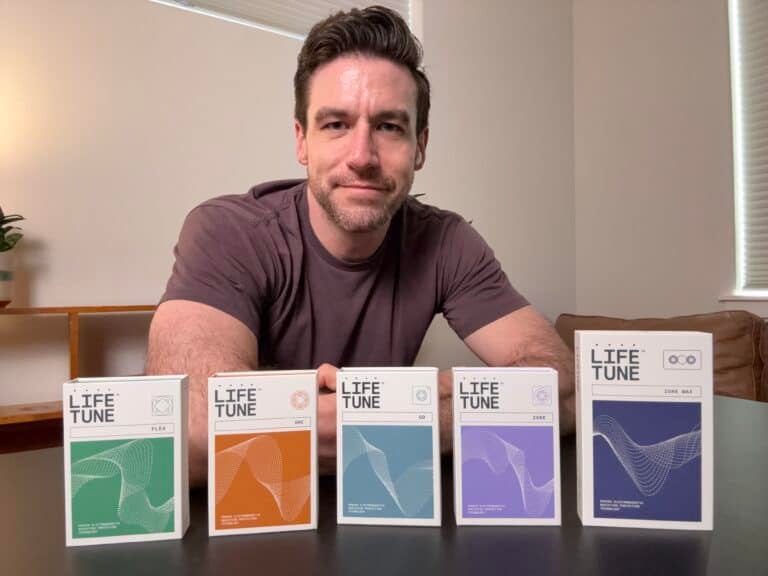
Aires Tech says its LifeTune products change the structure of electromagnetic fields rather than block radio signals. That is a proposed mechanism, not proof that wearing a device or attaching one to a phone prevents illness. The sources reviewed for this update do not establish the broad health-protection claims made in the earlier version of this article.
There is research to examine, including computer modeling, a published rat experiment and company summaries of human EEG studies. Each answers a different question. Below, I separate what was measured from what a buyer might reasonably want to know: whether a particular product offers a meaningful health benefit in everyday use.
For product shapes and my previously documented experience with them, see my Aires Tech review. This article focuses on the mechanism and evidence. The earlier 30% EMFA coupon has been removed because its current validity has not been verified.
Evidence reviewed October 8, 2026. This is a focused review of the sources linked below, not a systematic review of the entire Aires research archive.
How does Aires Tech say LifeTune works?
On its technology overview, Aires describes a passive semiconductor with a repeating, fractal surface pattern. The company says this pattern changes a field’s coherence properties while leaving signal amplitude unchanged. It calls that process structural field modulation and says the device requires no battery or charging.
That differs from a claim that a shield reduces the strength of an RF signal. It also means that a functioning phone, unchanged reception or a product’s patterned surface cannot demonstrate a health benefit. The effect being claimed needs its own measurements and controls.
The earlier version compared the mechanism to noise-canceling headphones. I have removed that analogy: it makes the explanation sound familiar without establishing that these passive products cancel exposure or prevent harm.
What does the research actually show?
A useful way to read an EMF product study is to ask three questions: what device was tested, what was measured and how closely the experiment resembles the use being advertised. Evidence about a material’s response to a field is different from evidence about an animal, and both differ from a demonstrated benefit for people.
Computer modeling: a possible physical mechanism
A Springer conference chapter first published online in 2022 models a patterned semiconductor wafer’s response to electromagnetic radiation. Its abstract describes electric polarization and the distribution of charges under the surface relief.
The publisher’s abstract was available for this review; the subscription chapter was not. The abstract concerns a physical model. It does not report a human trial or establish that a retail LifeTune product prevents disease. A plausible mechanism would still need to be connected to a measured, repeatable benefit under relevant conditions.
A 2019 rat experiment: a specific biological endpoint
The full text of a 2019 paper in Ecological Genetics describes male rats exposed to a 2.4 GHz Wi-Fi router for six hours a day over four days. Groups contained about 8–10 animals. One condition used six Aires Defender Pro resonators around a Faraday enclosure.
The researchers reported fewer chromosome disturbances in bone-marrow cells with resonators present than with the router alone. The response varied by rat strain; in Wistar rats, the reported level remained above the control groups. One author’s listed affiliation was the Aires Human Genome Foundation.
Those findings deserve to be described accurately. They are not a human clinical result, a test of a single pendant on a pet’s collar, or evidence that every current LifeTune model prevents illness. The enclosure, six-device arrangement and biological endpoint matter when interpreting the result.
Human EEG reports: useful questions, limited access
Aires publishes a summary of a 2024 report describing 24 healthy men aged 20–24, a GSM phone, EEG and ECG measurements, and a seven-day use stage. The company reports changes toward baseline with LifeTune One.
For this update, the material reviewed was the manufacturer’s summary, not the original report and raw data. That limits assessment of the methods, effect sizes and practical significance. A change in an EEG measure alone does not show that a product prevents a disease or improves a buyer’s health.
The archive also includes a 2025 human-study summary describing a double-blind protocol and seven-day follow-up. Its subject details list 14 men aged 20–24, while the archive entry says 24 subjects. That discrepancy needs the original report to resolve. I have not treated the summary as a verified, complete clinical trial report.
These reports should not be dismissed simply because the manufacturer discusses them. They also should not be presented as proof of protection for children, pregnant people, pets or the wider population without evidence that supports those uses.
What would stronger evidence need to establish?
For a health-protection claim, I would want a clear chain from the product sold to the outcome promised. That means the exact model, a realistic exposure setup, a suitable control or sham device, and enough information about allocation, blinding and analysis to judge the result. Independent replication would help show whether the effect holds up beyond one research group.
The outcome also needs to matter to the buyer. A field measurement, EEG change or laboratory marker is not automatically a reduction in symptoms or disease risk. The size and duration of any benefit, the population studied and possible unwanted effects all need attention.
Patents, awards and money spent on research cannot fill those gaps. They may describe a company’s technology or history, but they do not by themselves establish that a product delivers the health outcome being advertised.
How should the product pictures and placement advice be read?
The images below were retained from the earlier version of this article. They illustrate product form and placement, not experimental results. Names, housings and instructions can change, so use the instructions supplied with your exact model rather than assuming an older image applies to a current product.
A device attached to a phone

The previous guide described attaching a small adhesive device to a phone or case. Adhesion and placement are practical installation questions. Neither a secure attachment nor the fact that the phone still works proves that the user is protected. I have removed the statement that placement does not matter because protection is guaranteed.
A portable product

In the original article, I described keeping my portable product in a wallet because it fit there. That is an observation about convenience, not a measurement of exposure or a clinical test. Carrying a product in a wallet, pocket or pouch does not establish a health benefit.
A room or desk product
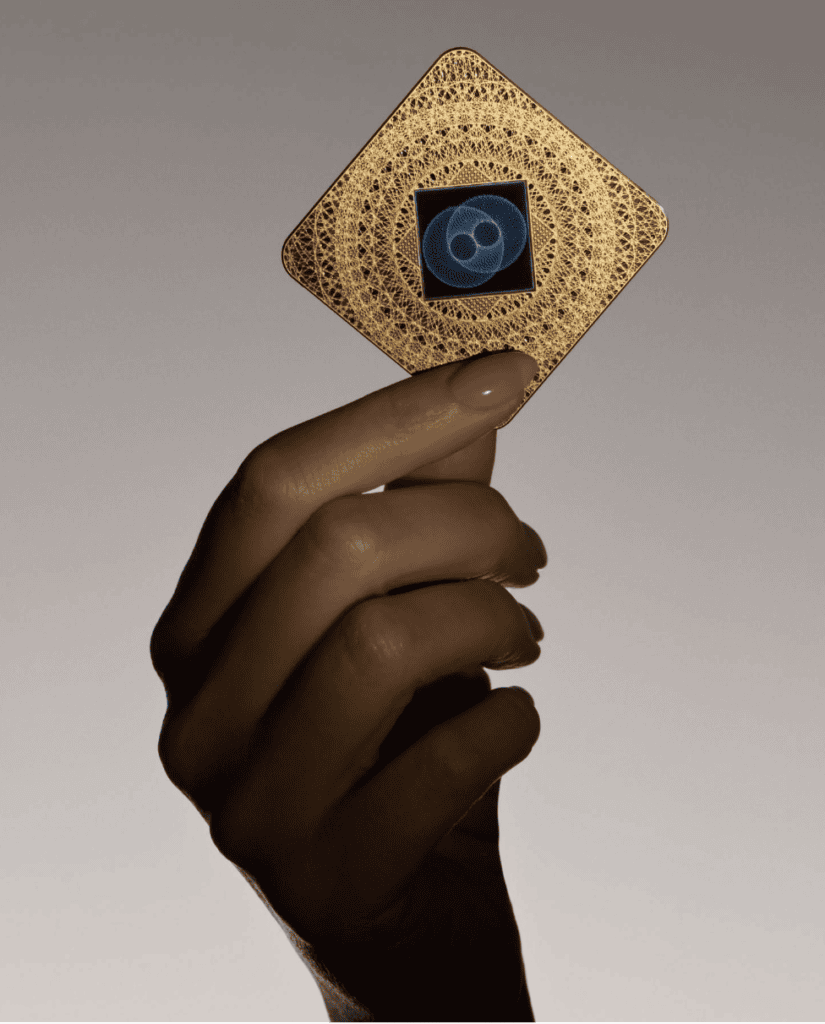
Putting a device on a desk or wall should not be described as making the room safe from all EMF. A room contains different sources, frequencies and distances. A claim about an entire space needs evidence for that use, not just a product photo or an unrelated test arrangement.
A product clipped to a bag or collar

The earlier pet instructions included an unfinished sentence and a broad waterproof claim. Those have been removed. Check the exact model’s care and attachment instructions; a clip or key ring does not establish protection for an animal. The rat experiment discussed above was not a trial of a collar-mounted product.
Can an EMF meter tell you whether Aires works?
A meter can help compare the particular field it is designed to measure under controlled conditions. It cannot diagnose a health problem or establish that a product prevents one. Because Aires describes structural modulation rather than reduced signal amplitude, a simple before-and-after RF strength reading does not test every part of its claim.
If you want to investigate a source in your home, first identify whether you need RF, electric-field or magnetic-field measurements. Keep the source activity, distance, orientation and meter settings consistent. My EMF meter guide explains model differences and limitations before you buy.
What can you do without buying a LifeTune product?
The FDA’s cell-phone guidance says the overall scientific evidence has not linked cell-phone RF radiation to health problems. That statement concerns cell-phone RF; it should not be stretched into a claim about every kind or level of electromagnetic exposure. It also is not an endorsement of Aires.
For people who want to reduce phone RF exposure, the National Cancer Institute describes practical options: spend less time on calls, use speaker mode or a headset to put distance between the phone and your head, and avoid calls when reception is weak. Do not text while driving.
These steps address exposure directly and do not require buying a device advertised to neutralize harm. They are not a promise of a health benefit either. If symptoms are the reason you are considering a product, discuss them with a qualified clinician rather than using a purchase as a diagnosis or treatment.