How to Reduce 5G Exposure: Practical Choices and Limits
*The information on EMF Academy is for educational purposes only and is not a substitute for professional medical advice. Please review our full Medical Disclaimer for more details. This post may contain affiliate links. Please see my disclosure to learn more.
If you prefer to reduce exposure from your phone, start with ordinary choices: use speakerphone or a compatible headset, keep calls short, and make calls where reception is strong. Check cellular, Wi-Fi and Bluetooth settings separately when you want to disconnect. Buying a product labeled “5G protection” does not establish that it protects your health.
Cellular 5G is a generation of mobile technology, not one frequency and not the same thing as 5 GHz Wi-Fi. Before choosing a meter or shielding material, identify the signal and what you want to measure or change. The sections below explain the phone settings, frequency limits and evidence to check.
What is 5G cellular, and is it the same as 5 GHz Wi-Fi?
The G in cellular 5G means generation. GHz is a unit of frequency. A Wi-Fi network name containing “5G” often refers to a router’s 5 GHz band, but a network name alone does not verify its settings. A home may use 5G cellular service for internet access and then distribute that connection over Wi-Fi or Ethernet; those are different links.
Cellular 5G uses low, mid and higher-frequency bands. It is inaccurate to describe all of it as 30–300 GHz millimeter waves. The Verizon spectrum explainer describes low-band, C-band and millimeter-wave service. These examples concern that provider and U.S. spectrum, rather than every band used around the world.
| Term | Example from the provider’s explanation | What it does not tell you |
|---|---|---|
| Low-band 5G | Bands below 1 GHz can provide broader coverage. | Your exposure at a particular place or the output of a particular phone. |
| Mid-band 5G | The U.S. C-band example is 3.7–3.98 GHz. | That every 5G connection uses this range. |
| High-band / mmWave 5G | Verizon describes operation between 24 and 40 GHz. | That a meter ending at 6 or 10 GHz can measure those signals. |
Existing large tower sites and small cells can both be part of a network. Do not assume every street fixture is a 5G transmitter, that every smart appliance connects directly to cellular 5G, or that an antenna’s appearance establishes the signal reaching your home.
What does the health evidence say?
Radiofrequency signals are non-ionizing radiation. The UK Health Security Agency’s explanation of electromagnetic fields, updated in May 2026, distinguishes them from radiation capable of ionizing matter. Sufficiently strong RF exposure can cause heating, so field strength, frequency and exposure conditions still matter. Calling a signal non-ionizing is not a claim that every possible exposure is harmless.
UKHSA’s 5G guidance, updated July 9, 2025, reports that its measurements around UK 5G base stations were well below ICNIRP guidelines. It notes fewer studies at higher frequencies and describes ongoing evidence review. That is not a basis for saying the technology is completely untested or that higher frequency alone makes 5G categorically more dangerous.
The Australian radiation-protection agency ARPANSA also reports no established health effects from low-level exposure to mobile and NBN base-station signals based on current research. These assessments concern exposure and the evidence reviewed; they are not clinical trials showing that a particular sticker, case or room device protects you.
IARC classified radiofrequency fields as possibly carcinogenic in 2011. UKHSA explains that the classification relied largely on limited evidence associated with wireless-phone use, while evidence for environmental exposures was inadequate to draw conclusions. That classification should not be rewritten as proof that 5G causes cancer or proof that a protection product prevents it.
The distinction matters when reading alarming headlines or product pages. A reported biological change, a modeled field pattern and an illness outcome are different findings. Ask which one was studied, at what exposure, and whether the result applies to the device and claim being discussed.
Practical ways to reduce exposure from your phone
If you would like to make a change, start with the device you actually use. UKHSA’s exposure-reduction guidance supports informed personal choices, including keeping the phone farther away during use, using hands-free equipment and making calls where reception is strong. It also considers additional community or individual measures for the much lower exposures from masts unnecessary.
Use speakerphone or a compatible headset
For a call, speakerphone lets you keep the handset away from your head. A compatible wired headset is another option when it suits the setting. Check the connector or adapter, microphone and comfort. You do not need a specialist air-tube headset to move the phone away from your ear.
Pay attention to where the phone ends up. Putting it into a pocket moves it away from your head but keeps it near another part of your body. There is no universal distance in this guide that guarantees a medical benefit or makes a connected phone exposure-free.
Check the radios before relying on airplane mode
Airplane mode is useful when you want to stop cellular communication, but inspect the other settings too. Apple’s current airplane-mode instructions say Bluetooth can remain enabled and Wi-Fi can still be used. Device behavior and remembered settings matter. Do not use the airplane icon as proof that every radio is off.
Decide how calls, messages, navigation and any required connection will work before disabling a radio. Downloading something to read or watch can let you use it offline, but it does not itself turn off the network connections. Keep important communication needs in mind when choosing when to disconnect.
Compare measurements in consistent conditions
Distance can help with exposure from a nearby handset, but do not convert an ideal inverse-square relationship into a fixed percentage reduction in illness risk. Actual conditions include the source, antenna arrangement, reflections, network activity and the phone’s changing transmit power. A calculation based only on distance is not a personal dosimetry result.
Choosing LTE instead of 5G, where a phone offers that setting, changes the connection technology. LTE still uses radiofrequency signals. It is not a switch that eliminates RF exposure, and a generation label alone does not tell you which setting produces a lower exposure in your situation.
What you can change at home
Start by identifying the connection. A Wi-Fi router connected to cable or fiber is not automatically a cellular 5G transmitter. A cellular home-internet gateway may use both a mobile-network link and Wi-Fi. Turning off one radio does not necessarily turn off the other.
Ethernet can replace a particular device’s Wi-Fi connection when the device and network support it. If your aim is to stop the Wi-Fi transmission, check the router and device settings separately. Connecting a cable without changing the relevant radios does not prove that all wireless activity has stopped.
For something you do not use, ordinary settings may let you disable an unnecessary hotspot or connection. Keep the change specific and check its effect on your household’s service. A router guard around equipment inside your home should not be presented as protection against every outside cellular source.
A question about an outside antenna needs a different assessment from a question about your own phone. Record its location, the place you are concerned about and any available operator information. An address or tower map is not a field measurement. Do not assume that a nearby antenna makes the whole property unsafe.
Before buying shielding paint, curtains or enclosures, define the job you want them to do. Our EMF product guide explains what to check. A material report needs the relevant frequency and installation conditions, and reducing a signal at one point is not evidence of a health benefit.
Can an EMF meter measure 5G?
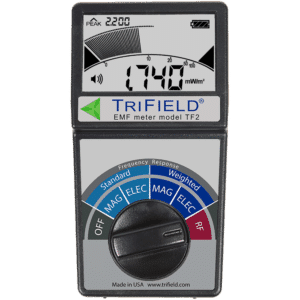
An RF meter measures signals within its specified response. A broadband reading generally combines sources within that response; it does not identify a signal as 5G simply because the display changes. AC magnetic and electric modes are different functions and are not substitutes for an RF measurement.
Match the actual frequency of interest to the instrument rather than relying on the word 5G in a listing. The TriField TF2 pictured here and the GQ EMF-390 are different instruments, with different specifications.
| Instrument or task | Reviewed manufacturer information | Practical limit |
|---|---|---|
| TriField TF2 RF mode | The maker specifies 20 MHz–6 GHz. | Signals above its stated upper frequency are outside that specified range; it cannot be called an all-band 5G meter. |
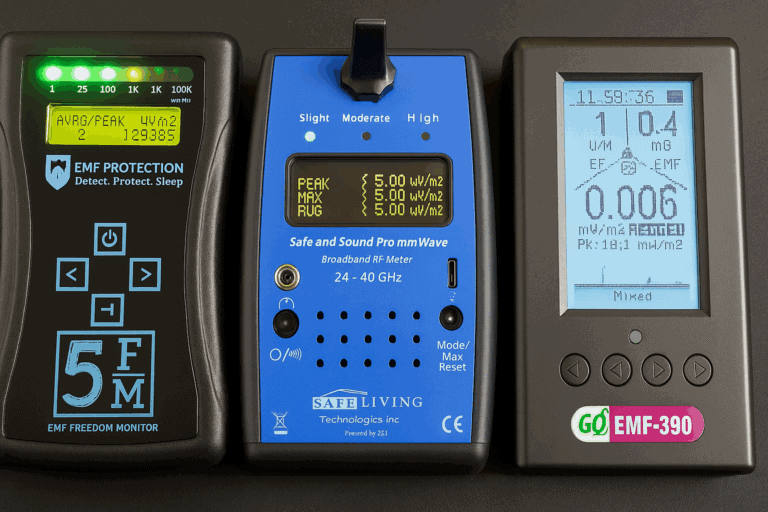
| GQ EMF-390 RF functions | The maker advertises RF detection up to 10 GHz and selected spectrum bands up to 2.504 GHz. | Broadband detection coverage is not the same as frequency-resolved spectrum coverage. Neither upper figure covers the high-band examples above. |
| A measurement at mmWave frequencies | Needs equipment and a method suited to the particular frequency and signal. | Do not treat a low reading on an out-of-band consumer meter as evidence that the source is absent. |
A consumer meter can be useful when the measurement fits its capabilities. Read the instructions for orientation, response, units and range, and record the sensor position and device settings. A repeatable on/off comparison for your own equipment may be informative, but network traffic and other nearby sources can change between observations.
A consumer meter is not a SAR test, a diagnosis or a complete regulatory compliance assessment. A zero value can mean that a field is below the instrument’s displayed sensitivity, outside its response or missed by the chosen observation. A red warning or a large number is also not a diagnosis.
Start with the EMF meter comparison if you need an instrument for a defined task. For an antenna assessment against a guideline, choose a qualified specialist with suitable frequency-selective or otherwise appropriate equipment and a documented method.
Aires Tech and other “5G protection” claims
I originally featured Aires because I had ordered its products, liked the customer service and could find descriptions of its research. Those are buying impressions, not clinical evidence. Defender Pro, Shield Pro and Lifetune Room are historical names used in the earlier guide. They should not be assumed to match today’s Lifetune versions.

Aires’ current technology overview describes structural field modulation without attenuation and says signal amplitude remains unchanged. That differs from lowering a measured RF field strength throughout a room. I would not describe its devices as removing all nearby emissions or turn the earlier 5-foot, 16-foot or 500-square-foot claims into a verified safety boundary.
Defender Pro and personal-device claims
A small device carried in a wallet is a convenient format, but the format does not establish protection from every phone, power line or tower nearby. Check the exact current product and the claimed outcome. An effective-radius statement needs relevant evidence; a radius in marketing copy is not a clinical result.
Shield Pro and device-sticker claims

An attachment to a phone or router does not by itself establish a reduction in exposure or a health benefit. A test for one phone, frequency or biological measurement cannot automatically establish every device and every 5G band. I had Aires products on electronics in my office when I wrote the earlier guide. That experience cannot establish a laboratory result or a health benefit.
Lifetune Room and area-protection claims
A device advertised for a bedroom or office needs evidence for the exposure and outcome being promised. A square-foot figure alone does not explain a three-dimensional field, the sources inside and outside the space, or what was measured. I would not tell a parent that the room has become medically protected after installing it.
The Aires research and technology review separates the company’s claims from the studies and summaries reviewed. It does not establish complete protection from 5G. Before paying for any brand’s accessory, ask for evidence matching the exact product and outcome, rather than counting patents, awards or research links.
How to ask a useful question about a local antenna
If you want information about a local installation, use the operator’s information or the relevant local authority’s planning and compliance process. Be specific about the site and the question: the operator, technology, applicable assessment or public measurement report. A photograph and a broadband meter reading are not enough to identify a frequency, prove a breach or attribute symptoms.
Keep a planning or measurement question factual. Identify the installation and the information you need without treating an antenna’s presence as proof of a health problem.
Frequently asked questions
Is 5G the same as 5 GHz Wi-Fi?
No. Cellular 5G is a generation of mobile technology. 5 GHz describes a Wi-Fi frequency band. A cellular home-internet gateway may use both cellular and Wi-Fi connections.
Does every 5G network use millimeter waves?
No. 5G uses low, mid and higher-frequency bands. The band and signal at a location need to be identified rather than inferred from the generation label.
Can the TriField TF2 measure every 5G signal?
No. Its manufacturer specifies an RF range of 20 MHz–6 GHz. Higher-band signals outside that range require suitable equipment; a low TF2 reading does not establish their absence.
Does airplane mode turn off all wireless signals?
Not necessarily. Apple’s instructions say Bluetooth can remain enabled and Wi-Fi can be used in airplane mode. Check the relevant settings on your device and plan for any communication you need.
Do patents or a protection radius prove a health benefit?
No. Those claims do not replace evidence for the particular product, exposure conditions and health outcome. A laboratory or modeled result should not be generalized beyond what was studied.